Seek-Chat: DeepSeek vs Google Gemini: Which AI Is Better for Coding, Research, Pricing, and Everyday Use?
DeepSeek vs Google Gemini is really three decisions: DeepSeek Chat versus the Gemini app, DeepSeek’s hosted API versus the Gemini API, and DeepSeek’s open-weight options versus Google’s proprietary model ecosystem. The right choice changes with the layer you actually plan to use.
Competitor source check — September 7, 2026. Google’s Gemini API model list was re-read on this date: it carries gemini-3-pro-preview, gemini-3-flash-preview and the 2.5 family, and no Gemini 3.1 Pro entry, which is why the 3.1 Pro Preview material here is labeled historical. The Artificial Analysis comparison was re-read on this date and its result is quoted in full below. The Reuters article of April 24, 2026 could not be re-read — reuters.com returns 401 to non-browser requests — so it is cited by date rather than re-verified.
Provider facts rechecked August 27, 2026: DeepSeek’s hosted API catalog contains deepseek-v4-flash, deepseek-v4-pro, and experimental deepseek-v4-flash-vision-exp. Vision Exp adds image understanding with text output; it does not turn the DeepSeek API into an audio, video, general-document, or image-generation platform. Google now lists the production-ready gemini-3.7-flash as its current Flash baseline. The July 28, 2026 screenshots and DeepSeek-only fixture below remain historical evidence and are labeled as such.
Evidence disclosure — documentation-based comparison; DeepSeek tested, Gemini not tested live. On July 28, 2026, we ran one synthetic text task on DeepSeek Chat and the DeepSeek API only. We did not run the Gemini app or Gemini API because authenticated access was unavailable. Current capability, pricing, modality, integration, and privacy statements are based on first-party documentation reviewed through August 27, 2026, unless a different date is stated. This page does not establish a winner for coding, reasoning, research, multimodal quality, latency, reliability, productivity, or cost per successful task.
Evidence-Bounded Overview
Based on the published interfaces and prices checked for this article, DeepSeek is a candidate to evaluate when listed token cost, long context, compatible API formats, open-weight text releases, or experimental image understanding are central requirements. The dated original task on this page was run only on DeepSeek and does not establish a DeepSeek-versus-Gemini quality result.
Gemini is a candidate to evaluate when the workflow requires Google’s documented support for audio, video, PDFs, Search grounding, code execution, Computer Use, image-generation products, or Google-product integration. Those capability differences do not prove that Gemini will produce better text, code, research, or image answers on a specific workload.
Evidence boundary: No matched winner is reported here for coding, reasoning, research, multimodal quality, latency, reliability, or cost per successful task. Test the current products and model IDs on the same inputs and scoring rules before choosing.
DeepSeek vs Google Gemini at a Glance
| Decision | DeepSeek | Google Gemini | Evidence level |
|---|---|---|---|
| Current API baseline | V4 Flash-0731 Public Beta; V4 Pro-0813 GA; V4 Flash Vision Exp Experimental | Gemini 3.7 Flash GA; older 3.6/3.5 and 3.1 references below are dated checkpoints | Both providers rechecked August 27, 2026; historical rows retain their original dates |
| Context | 1M for all three current API models | 1,048,576 input tokens for Gemini 3.7 Flash | Official specifications; effective retrieval still needs matched testing |
| Maximum output | Up to 384K for all three current API models | 65,536 output tokens for Gemini 3.7 Flash | Official specifications |
| Image understanding | Yes, through experimental Vision Exp; text output | Yes, across applicable Gemini models | Documented capability; no new shared image benchmark was run |
| Audio, video, and PDF input | Not documented for the current DeepSeek API; Files is image-only | Documented across applicable Gemini models | Capability scope, not an output-quality score |
| Image generation | Not documented for Vision Exp | Available through Google’s applicable image-generation products/models | Do not confuse image understanding with generation |
| Built-in tools | JSON output, tool calls, Responses, and Anthropic compatibility for all three; Responses also documents server-side web_search | Function calling, grounding, code execution, URL context, and Computer Use depending on model/product | Documented feature fit |
| DeepSeek API cost | Vision Exp uses the same token rates as Flash; Pro is higher; time-aware schedule | Higher listed rates in the July 28, 2026 rows below, with separate grounding and caching economics | Check live provider pricing before budgeting |
| Original test status | July 28, 2026 Chat and text-API fixture completed; Vision not tested | Not run: authenticated Gemini access was unavailable | No fabricated cross-provider score |
| Open weights | Available for the applicable V4 releases; no open-weight claim is made here for Vision Exp | Gemini models are proprietary | Official licenses/model pages |
| Privacy scope | Chat, hosted API, Files, and self-hosting are different surfaces | Consumer app, unpaid API, paid API, and Workspace have different terms | Read the terms for the exact product |
What Are You Actually Comparing in 2026?
A brand name is not a test configuration. Record the exact model ID, product surface, region, plan, tool settings, and test date before comparing results.
DeepSeek: V4 Flash, V4 Pro, and Vision Exp
DeepSeek’s current models and pricing page lists three IDs. deepseek-v4-flash serves DeepSeek-V4-Flash-0731 in Public Beta; deepseek-v4-pro serves DeepSeek-V4-Pro-0813 in GA; and deepseek-v4-flash-vision-exp serves experimental DeepSeek-V4-Flash-Vision-Exp. All three list a 1M context, a maximum 384K output, thinking/non-thinking modes, JSON output, tool calls, Responses, Anthropic compatibility, and chat-prefix completion. FIM is not supported on Vision Exp.
Flash and Pro accept text. Vision Exp supports text and image input with text output. Images can be provided by URL, Base64, or an image file_id from the Files API. The Files API is documented for JPEG, PNG, GIF, and WebP images—not PDF, DOCX, CSV, ZIP, audio, video, Batch, RAG, or general file search. Vision Exp understands images but does not generate them.
DeepSeek had announced that the legacy deepseek-chat and deepseek-reasoner aliases would be retired after July 24, 2026. Their HTTP 200 behavior in this site’s July 28, 2026 test remains a dated compatibility observation, not a promise. Production code should use one of the three documented V4 IDs.
Google: consumer Gemini, Gemini API, and Workspace
Google’s latest-model guide lists gemini-3.7-flash as generally available and ready for production. Google positions it for complex coding, agents, multimodal reasoning, and multi-step execution, with a 1,048,576-token input limit, 65,536-token output limit, and low/medium/high thinking levels. Older Gemini 3.6 Flash, 3.5 Flash-Lite, and 3.1 Pro references on this page are retained only where they describe the dated July 28, 2026 checkpoint.

The Gemini consumer app, the unpaid Gemini API/AI Studio tier, paid API use, and Gemini for Workspace do not share one feature or privacy contract. This article separates them wherever the distinction changes the recommendation.
Which Product Should You Evaluate First?
| User type | Documentation-based starting point | Evidence boundary |
|---|---|---|
| Casual user | Evaluate Gemini for documented feature breadth; test both for text | Gemini documents a broader mixed-media and Google-integrated product surface. Everyday answer quality was not compared here. |
| Developer building high-volume text tools | Evaluate DeepSeek’s listed API economics | DeepSeek documents compatible API formats; token-rate comparisons depend on the exact model, cache category, and time band. Throughput, reliability, and cost per successful task were not compared. |
| Developer building image-understanding tools | Test both | DeepSeek Vision Exp and applicable Gemini models document image input; image-answer quality was not compared. |
| Developer needing audio, video, PDFs, or image generation | Evaluate an applicable Gemini product | Google documents these modalities or adjacent products; they are outside the documented scope of DeepSeek Vision Exp. |
| Coding-heavy user | Test both | DeepSeek documents lower-cost text routes and image input through Vision Exp; Gemini documents code execution, tools, grounding, and broader media support. Coding quality was not compared. |
| Researcher | Evaluate the required retrieval surface | Gemini documents broad grounding and Google integration; DeepSeek Responses documents server-side web search. Citation quality was not compared. |
| Student | Evaluate by required modality and product terms | Gemini documents broader media and Google integration; DeepSeek documents lower-cost API routes. Learning quality and factual accuracy were not compared. |
| Business/team | Evaluate governance and workflow fit | Compare the exact Workspace, Gemini API, DeepSeek API, or self-hosted route and its contract; no business productivity test was run. |
| Privacy-sensitive user | Evaluate the exact deployment and terms | Review the hosted, Files, enterprise, or self-hosted surface before sending sensitive data. |
| Open-weight deployment | Evaluate applicable DeepSeek releases | Applicable V4 text releases publish weights; this page makes no open-weight claim for Vision Exp. |
| Google Workspace user | Evaluate Gemini’s native integrations | Google documents integration with Gmail, Docs, Drive, and Workspace; productivity outcomes were not tested here. |
Coding: Documented Fit, Not a Tested Winner
This article does not contain a matched coding benchmark. DeepSeek documents low listed token rates, long context, and OpenAI- and Anthropic-compatible interfaces. Those properties may reduce integration or token cost, but they do not establish code correctness, repository-task completion, tool reliability, or developer repair time.
DeepSeek documents compatible API interfaces, low listed token rates, and long context for applicable routes. These properties can justify evaluation in coding tools and agent frameworks, but this page did not measure code correctness or completed repository tasks.
Gemini documents coding and agent capabilities alongside function calling, code execution, grounding, multimodal input, and other built-in tools on applicable models and products. That broader documented tool surface does not establish superior coding quality without a matched repository test.
Coding Evaluation Starting Points
Evaluate DeepSeek when listed token economics, long-context text, compatible request formats, or open-weight deployment are requirements.
Evaluate Gemini when code execution, Google tools, grounding, or broader file and media inputs are requirements. Run both on the same repository issues, permissions, tools, tests, and acceptance criteria before making a coding-quality claim.
If you are building production software, test both on your own codebase. Coding benchmarks are useful, but real-world performance depends on your language, framework, repository size, prompt design, and whether the model can use tools.
Research and Grounding: Documented Tool Differences
Gemini retains the broader documented research-tool fit across Google Search grounding, URL context, connected Google files, and other product-specific tools. Google’s Gemini pricing documentation lists grounding economics separately, so budget query-based charges beyond token usage.
DeepSeek is no longer limited to caller-supplied research context on every API surface. Its current stateless Responses API documents server-side web_search across the current model choices. Normal Chat Completions still has no provider-hosted search tool and requires the caller to execute retrieval functions. DeepSeek does not document a first-party Google or X-specific search equivalent.
Practical research recommendation
Evaluate Gemini when the workflow specifically requires Google Search grounding, URL context, connected Google files, or Google’s research products. Evaluate DeepSeek Responses when its documented server-side web search, long context, and listed rates fit the architecture. Use DeepSeek Chat Completions with caller-controlled retrieval when that control is required. This page did not compare citation correctness, source quality, freshness, coverage, or research-task completion.
For either provider, preserve source URLs and verify important technical, medical, financial, legal, security, and regulatory claims against primary sources.
API Pricing: Provider Rates Rechecked August 27, 2026
The following rates are official list prices per 1 million tokens, rechecked August 27, 2026. Gemini 3.7 Flash uses introductory pricing through December 31, 2026; Google says standard pricing begins January 1, 2027. These are not universal cost-per-success rankings: caching, image tokenization, grounding, retries, output length, and successful-task rate can change the bill.
| Model | Cache-hit input | Cache-miss / standard input | Output | Important qualifier |
|---|---|---|---|---|
| DeepSeek V4 Flash | $0.007 off-peak / $0.014 peak | $0.22 off-peak / $0.44 peak | $0.66 off-peak / $1.32 peak | Current text route; 2,500-account concurrency |
| DeepSeek V4 Pro | $0.022 off-peak / $0.044 peak | $0.66 off-peak / $1.32 peak | $1.98 off-peak / $3.96 peak | Current Pro route; 500-account concurrency |
| DeepSeek V4 Flash Vision Exp | $0.007 off-peak / $0.014 peak | $0.22 off-peak / $0.44 peak | $0.66 off-peak / $1.32 peak | Experimental; Vision Exp uses the same token rates as Flash; images become input tokens |
| Gemini 3.7 Flash | See Google’s live caching table | $0.75 introductory input | $3.75 introductory output | GA; introductory rate through December 31, 2026, then Google says $1.50 input / $7.50 output |
| Gemini 3.6 Flash | See Google’s live caching table | $0.75 introductory input | $3.75 introductory output | Previous generation; Google applies the same introductory rate through December 31, 2026 |
| Gemini 3.5 Flash-Lite | See Google’s live pricing | See Google’s live pricing | See Google’s live pricing | Historical July 28, 2026 lower-cost checkpoint; verify current availability and rates |
| Gemini 3.1 Pro Preview | See Google’s live pricing | See Google’s live pricing | See Google’s live pricing | Historical preview checkpoint; migrate current production comparisons to 3.7 Flash |
DeepSeek schedule: peak applies Monday through Friday during 01:00–04:00 and 06:00–10:00 UTC (09:00–12:00 and 14:00–18:00 Beijing time). All other times are off-peak, including weekends. Vision images are converted into input tokens based on dimensions and billed with text input; the official table does not add a separate per-image fee.
The listed rates do not establish a blanket price winner: compare the exact model, input-cache category, and peak or off-peak band. Token prices alone do not establish the lowest cost per successful multimodal, grounded, or tool-using task. Use Google’s live Gemini pricing, DeepSeek’s current pricing, the site’s pricing guide, and its DeepSeek API cost reference immediately before budgeting.
DeepSeek-Only Original Test Evidence — Gemini Was Not Run
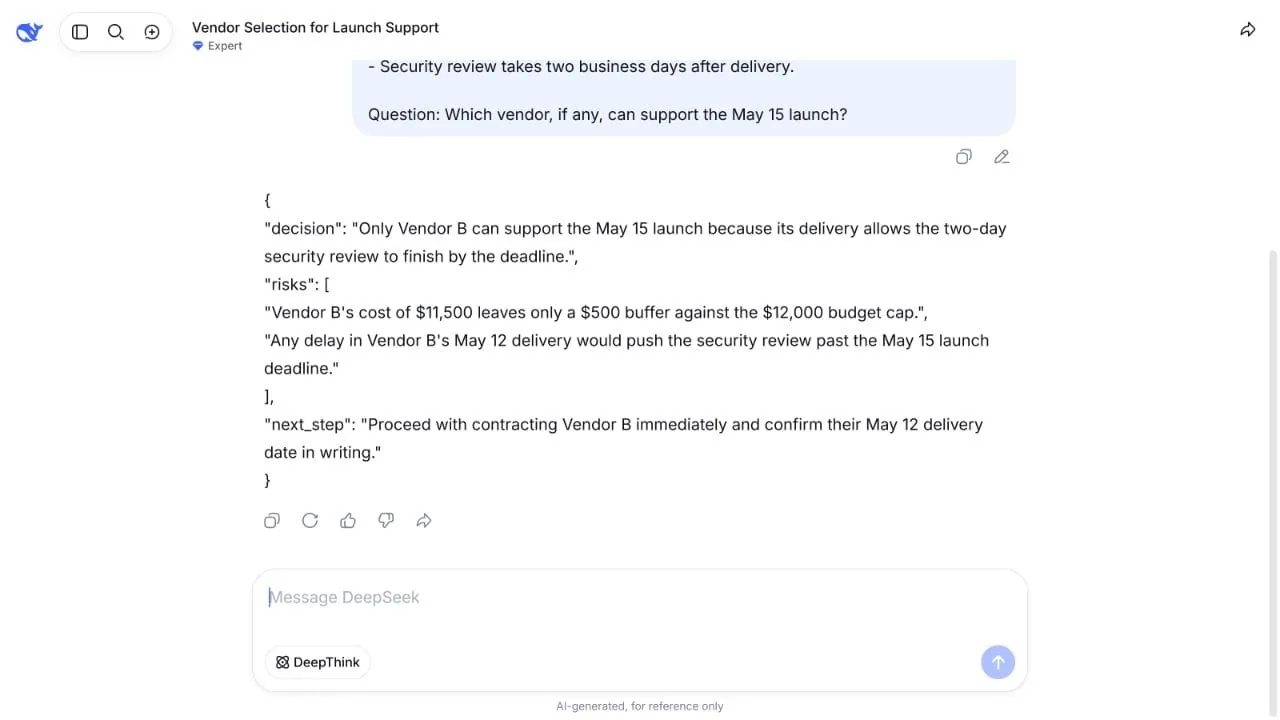
Tested July 28, 2026. We used one English synthetic vendor-selection fixture with explicit numeric constraints and required JSON output. It is useful for showing instruction adherence and reasoning-budget behavior, but one fixture is not a general intelligence or speed benchmark.
| DeepSeek run or missing comparator | Observed result | Interpretation |
|---|---|---|
| DeepSeek Chat — Instant | Returned JSON but selected the wrong vendor and contradicted the supplied constraints | Schema compliance did not guarantee decision correctness |
| DeepSeek Chat — Expert | Selected Vendor B correctly and returned the requested JSON | Correct on this fixture |
deepseek-v4-flash API | Correct; 162 prompt tokens, 205 completion tokens, 127 reasoning tokens, 2,160 ms elapsed | Single-run observation only |
deepseek-v4-pro API, 500 max tokens | Used the full allowance for reasoning and returned no final content | Reasoning models need an adequate output budget |
deepseek-v4-pro API, 1,600 max tokens | Correct; 162 prompt tokens, 701 completion tokens, 574 reasoning tokens, 12,259 ms elapsed | Successful retest; not a general latency claim |
| Gemini | Not run | Authenticated Gemini app and API access were unavailable; no output or score was fabricated |
How to reproduce a fair cross-provider test
- For a current text baseline, compare
deepseek-v4-flashwithgemini-3.7-flash. Record Gemini’s thinking level and DeepSeek’s thinking mode/effort rather than pairing V4 Pro with an older preview by name alone. - For images, run a separate matched benchmark using
deepseek-v4-flash-vision-expand the applicable Gemini image-capable model with identical source images and expected answers. Do not reuse the July 28, 2026 text fixture as Vision evidence. - Run at least three repetitions per synthetic task and publish prompts, expected answers, exact model IDs, date, region, image detail setting, and reasoning/tool settings.
- Score correctness, groundedness, JSON/schema validity, tool-call validity, retries, token usage, latency, and official cost per successful task.
- Record unsupported modalities as N/A. Test PDF, audio, video, search grounding, Computer Use, and image generation separately from shared text and image-understanding tasks.
- Use provider defaults where controls are not equivalent; do not claim an equal-temperature or equal-effort test when the controls map differently.
Until that authenticated matched run is complete, this page reports a DeepSeek observation, current official specifications, and product-fit conclusions—not a head-to-head quality winner.
Multimodal Tasks: Documented Modality Coverage
Google documents a broader set of modalities and adjacent products across applicable Gemini surfaces, including images, audio, video, PDFs, connected Google files, grounding, and generation products. DeepSeek Vision Exp documents text-and-image input with text output. This is a capability-scope comparison; neither provider’s multimodal answer quality was tested here.
DeepSeek Vision accepts images through a public URL, Base64/Data URL, or an image file_id from the Files API. Files is documented for JPEG, PNG, GIF, and WebP images. It is not a general document API and does not establish native PDF, DOCX, CSV, ZIP, audio, or video support. Vision Exp does not generate images.
Multimodal Evaluation Starting Points
Evaluate an applicable Gemini product when the workflow requires:
- audio or video input
- native PDF/document workflows
- Google Drive or Workspace integration
- Google Search grounding and URL context
- image-generation products or broader mixed-media tooling
Evaluate DeepSeek Vision Exp when the workflow requires:
- screenshot, chart, UI, or photo understanding with text output
- image-grounded coding or agent tasks
- image reuse through
file_id - the same listed token rates and 2,500 concurrency as DeepSeek Flash
- an experimental image route alongside DeepSeek’s lower-cost text routes
This is a capability comparison. The July 28, 2026 fixture below did not include Gemini or Vision, so it cannot establish which provider produces better image answers.
Long Context: Published Limits, Not Compared Retrieval Quality
DeepSeek and Gemini both publish large context limits for the named models, but this page did not run a matched long-context retrieval test. Published capacity does not establish how reliably either model finds, cites, or reasons over evidence at different positions in a long input.
DeepSeek’s three current API models list a 1M-token context window and maximum output up to 384K tokens. Flash and Pro are text models; Vision Exp can also accept images, with each image converted into input tokens. Gemini 3.6 Flash and Gemini 3.1 Pro Preview listed 1,048,576 input tokens and 65,536 output tokens at the page’s July 28, 2026 Google checkpoint.
In practice, long context does not automatically mean better answers. The model must still find the relevant information, reason over it correctly, and avoid confusing unrelated sections. For long documents, the best workflow is usually:
- Split the document into logical sections.
- Ask the model to extract key facts with citations or references.
- Compare extracted points before asking for final analysis.
- Use retrieval or file search when available.
- Verify important conclusions manually.
DeepSeek’s listed rates may justify a test for long text processing, while Vision Exp can add image context. Gemini documents native PDF, audio, video, connected-file, and grounding paths on applicable products. These are feature and price differences, not a long-context quality result.
Privacy and Data Handling: Read the Exact Product Terms
Privacy is one of the most important differences between DeepSeek and Google Gemini, especially for businesses, regulated industries, and sensitive data.
DeepSeek’s privacy policy states that personal data may be stored and processed in the People’s Republic of China, and that DeepSeek retains personal data as long as necessary for the purposes described in its policy and legitimate business or legal interests. It also states that no internet or email transmission is fully secure.
Google’s terms vary by product. For the Gemini API, Google’s additional terms distinguish between unpaid and paid services. The terms state that unpaid-service content may be used to provide, improve, and develop Google products and machine learning technologies, while paid-service prompts and responses are not used to improve Google products and are processed under the applicable data-processing terms.
For Google Workspace, Google states that Gemini for Workspace follows the organization’s existing controls and data handling, and that stored customer data is governed by Google’s Cloud Data Processing Addendum. Google also describes enterprise privacy, security, governance, and compliance controls for Workspace customers.
Practical privacy recommendation
Do not paste confidential, regulated, or sensitive data into either tool without checking:
- the exact product you are using
- whether it is free, paid, consumer, API, or enterprise
- data retention terms
- training/improvement terms
- region and data-transfer terms
- admin controls
- contractual protections
- compliance requirements
For individuals, Gemini may feel more familiar because of Google account integration, but that does not automatically make every Gemini product suitable for sensitive data. For businesses, Google Workspace’s enterprise controls may be more practical than consumer AI tools. For developers, the right answer may be self-hosting, private deployment, or using a provider with contractual guarantees.
DeepSeek Pros and Cons
DeepSeek Pros
- Low official API pricing for text-heavy workloads.
- Vision Exp uses the same token rates and 2,500-account concurrency as Flash.
- 1M context and up to 384K maximum output across all three current API models.
- Image understanding through URL, Base64, or reusable image
file_id. - OpenAI-compatible and Anthropic-compatible API options.
- Applicable V4 release artifacts support open-weight experimentation and deployment control.
DeepSeek Cons
- Vision Exp is experimental rather than GA.
- No documented native audio, video, PDF, or general-document input in the current DeepSeek API.
- Image understanding is not image generation.
- Less integrated with mainstream productivity apps than Google’s ecosystem.
- Hosted-service privacy and data-location considerations require review.
- Legacy aliases are retired/unlisted and should be removed from integrations.
Google Gemini Pros and Cons
Google Gemini Pros
- Documented support for text, images, video, audio, and PDFs on applicable models and products.
- Native integrations documented for applicable Google products and Workspace plans.
- Supports search grounding, URL context, tool use, function calling, and structured outputs on major models.
- Documented Search grounding, URL context, and research-oriented product features; research quality was not compared here.
- Enterprise options and Workspace controls are available.
- Broader documented consumer-product surface across mixed media and Google integrations.
Google Gemini Cons
- Pro-tier API models can be more expensive than DeepSeek for high-volume text generation.
- Some models are preview models, which can change.
- Features, limits, and pricing differ by model, region, and subscription tier.
- Users can become dependent on Google’s ecosystem.
- Free and paid services may have different data-use terms, so users must read the relevant product terms.
DeepSeek vs Google Gemini for Everyday Use
For everyday use, Google documents a broader consumer-product surface across mixed media, PDFs, Search, and Google-app integrations. DeepSeek documents a more focused chat and API product set, including text models and experimental image understanding.
Gemini supports a wider set of mixed tasks in one product: writing, summarizing, brainstorming, explaining documents, analyzing images, working with PDFs, and connecting with Google apps. Google AI subscription tiers also bundle access to Gemini features with storage and additional usage limits, depending on plan and region.
This article did not run a matched everyday-use test, so it does not rank answer quality, reliability, time saved, or user preference.
DeepSeek vs Gemini for Businesses and Teams
For businesses, the best choice is less about model intelligence and more about workflow, governance, risk, and cost.
Organizations already using Google Workspace may want to evaluate Gemini because Google documents native Workspace integration and enterprise administration, privacy, security, and governance features. This is an ecosystem-fit hypothesis, not evidence that Gemini improves business productivity or produces better answers.
Teams building custom systems may want to evaluate DeepSeek when listed API rates, compatible interfaces, long context, or open-weight text releases fit the architecture. Review the exact data terms, hosting path, access controls, security requirements, and total operating cost before using either provider with business data.
Business decision checklist
Evaluate Gemini when the documented requirement includes:
- Google Workspace integration
- admin controls
- enterprise support
- multimodal workflows
- search-grounded research
- document and email productivity
Evaluate DeepSeek when the documented requirement includes:
- model-specific API cost evaluation
- high-volume text processing
- coding and reasoning workflows
- open-weight experimentation
- flexible API integration
- self-managed evaluation and deployment
Historical Third-Party Benchmark Context — Not Current Matched Evidence
Benchmarks can help, but they should not be the only basis for choosing between DeepSeek and Google Gemini.
Artificial Analysis compares DeepSeek V4 Pro 0813 (Reasoning, Max Effort) with Gemini 3.1 Pro Preview using its own composite methodology. Its result, read on September 7, 2026: Artificial Analysis Intelligence Index 42 for DeepSeek V4 Pro against 37 for Gemini 3.1 Pro Preview, with a lower blended price per 1M tokens for DeepSeek. That result belongs to the named historical model pair and must not be transferred to Gemini 3.7 Flash or DeepSeek Vision Exp. It is a third-party directional signal, not evidence from this site and not a current workload-specific winner.
Vendor and third-party benchmark claims can help identify cases to test, but differences in model version, provider route, tools, prompts, judges, and token budgets prevent direct transfer to a production workload.
Reuters reported on April 24, 2026 that DeepSeek said V4 narrowed the gap with top closed models in areas such as cost, long context, and coding, while also noting caution around benchmark claims and limitations such as lack of multimodal capabilities at launch. That article was not re-read on September 7, 2026: Reuters blocks automated access, so treat the summary as our record of the April 24, 2026 report rather than a re-verified quotation.
The best practical benchmark is still your own test set:
- 20 real coding tasks
- 20 research prompts
- 10 long-document tasks
- 10 factual accuracy checks
- 10 workflow-specific prompts
- cost per successful result
- human review of final output quality
Documentation-Based Shortlist — No Head-to-Head Winner
For most people asking “DeepSeek vs Google Gemini: which is better?”, the accurate answer is:
Gemini documents broader mixed-media, grounding, generation, and Google-product coverage. DeepSeek documents one-million-token context, compatible API formats, open-weight text releases, and experimental image understanding. Its listed token rates vary by model, cache category, and time band. These differences can guide which product to test first; they do not establish a winner for coding, reasoning, research, image quality, reliability, or everyday use.
Evaluate DeepSeek first when the requirement is:
- low token cost
- coding and reasoning
- 1M-token text workflows
- experimental screenshot, chart, UI, or photo understanding with text output
- OpenAI/Anthropic-compatible integration
- applicable open-weight deployment options
Evaluate an applicable Google Gemini product first when the requirement is:
- audio, video, PDF, and broader multimodal input
- Google Search grounding and URL context
- Google Workspace integration
- image-generation products or broader media workflows
- team and enterprise controls
- connected productivity
A hybrid workflow can still make sense: use Gemini for Google-connected and broader media tasks, and use the applicable DeepSeek text or Vision route for cost-efficient reasoning. Treat image understanding, document support, and image generation as separate capabilities.
Update Log
- August 27, 2026: updated the current Google baseline to Gemini 3.7 Flash GA, added its introductory pricing and thinking/context/output limits, and preserved July 28, 2026 screenshots and test notes as historical evidence.
- August 24, 2026: added experimental DeepSeek Vision Exp, image URL/Base64/
file_idroutes, the image-only Files boundary, current Flash/Pro/Vision pricing, Monday–Friday peak windows, and corrected the distinction between image understanding and generation. Historical July 28, 2026 tests and images remain unchanged. - July 28, 2026: replaced retired Gemini baselines with Gemini 3.6 Flash and 3.5 Flash-Lite; updated pricing; documented the live DeepSeek model and alias checks; added the original DeepSeek fixture results and explicit Gemini access limitation.
- Testing policy: future cross-provider scores will be added only after the exact Gemini app/API account and model IDs are available.
FAQ: DeepSeek vs Google Gemini
Is DeepSeek better than Google Gemini?
This page does not establish a head-to-head quality winner. DeepSeek documents long context, compatible APIs, open-weight text releases, and experimental image understanding; the price comparison must use the exact model, cache category, and time band. Google documents broader audio, video, PDF, grounding, generation, and product-integration coverage across applicable Gemini surfaces. Test both on the same workload before making a quality claim.
Is DeepSeek or Gemini better for coding?
Evaluate DeepSeek for listed token rates, long-context code analysis, compatible APIs, or image input through Vision Exp. Evaluate Gemini when coding depends on code execution, Google tools, broader file and media handling, grounding, or its developer ecosystem. Coding quality was not compared; test both on the same repository and exact tool setup.
Which is cheaper, DeepSeek or Gemini?
There is no blanket lowest-price result across the models shown here; compare the exact model and input/output category under the applicable time band. Vision Exp uses the same rates as Flash: $0.007/$0.014 cache-hit input, $0.22/$0.44 cache-miss input, and $0.66/$1.32 output for off-peak/peak. Peak applies Monday through Friday during 01:00–04:00 and 06:00–10:00 UTC (09:00–12:00 and 14:00–18:00 Beijing time); all other times are off-peak. Compare cost per successful task, not token price alone.
Is DeepSeek free?
DeepSeek API usage is not simply free; official API pricing is billed per million tokens. Consumer access may vary by product, region, and capacity, so users should check DeepSeek’s current app and API pages before assuming availability or limits.
Does Gemini work better with Google apps?
Gemini provides native integrations with applicable Google products and Workspace plans. This article did not test productivity outcomes, answer quality, or time saved inside Gmail, Docs, Drive, or Workspace, so “better” should be understood as documented integration fit rather than a measured performance result.
Which AI is better for research?
Google documents Search grounding, URL context, connected-file features, and research-oriented Gemini products. DeepSeek Responses documents server-side web search, while Chat Completions requires caller-executed retrieval. This page did not compare citation correctness, source quality, freshness, or research completion, so it reports tool coverage rather than a research-quality winner.
Which one has better privacy?
There is no universal answer. DeepSeek’s privacy policy states that personal data may be stored and processed in the PRC. Google’s Gemini terms vary by free, paid, API, consumer, and Workspace products. Paid Gemini API services and Google Workspace have different data-handling commitments from unpaid consumer services. Always review the exact product terms before using sensitive data.
Can DeepSeek replace Gemini?
DeepSeek may be a viable candidate for text, coding, reasoning, or image-understanding API workflows whose required features it documents. It is not feature-equivalent where a workflow depends on Google apps, native audio, video or PDF handling, broader grounding, image generation, or Google’s enterprise product surface. Migration viability was not tested here.
Which one should developers use?
Evaluate DeepSeek Flash or Pro when listed token rates, long context, compatible APIs, or deployment control are requirements, and evaluate Vision Exp for image input with text output. Evaluate an applicable Gemini model when broader media types, Google grounding, code execution, or Google Cloud and Workspace integration are requirements. Run matched integration and quality tests before selecting a provider.
Is DeepSeek open source?
DeepSeek V4’s model card lists the model weights and repository under an MIT license. However, “open source” in AI can mean different things, including weights, code, training data, and full reproducibility. It is more precise to describe DeepSeek V4 as open-weight unless discussing the exact license and release materials.
Does Gemini support multimodal input better than DeepSeek?
Gemini still documents broader modality coverage across images, audio, video, and PDFs. DeepSeek is no longer text-only: experimental Vision Exp accepts images by URL, Base64, or image file_id and returns text. It does not document native audio/video/PDF input or image generation, so “broader” is accurate while “DeepSeek does not support images” is not.