Seek-Chat: DeepSeek Models
Last verified against DeepSeek’s current Models & Pricing page, August 21, 2026 changelog, Vision guide, and official Hugging Face model cards: September 3, 2026. No authenticated GET /models rerun was made for this editorial update; the catalog below follows currently published first-party documentation.
Model names, product names, and trademarks belong to their respective owners.
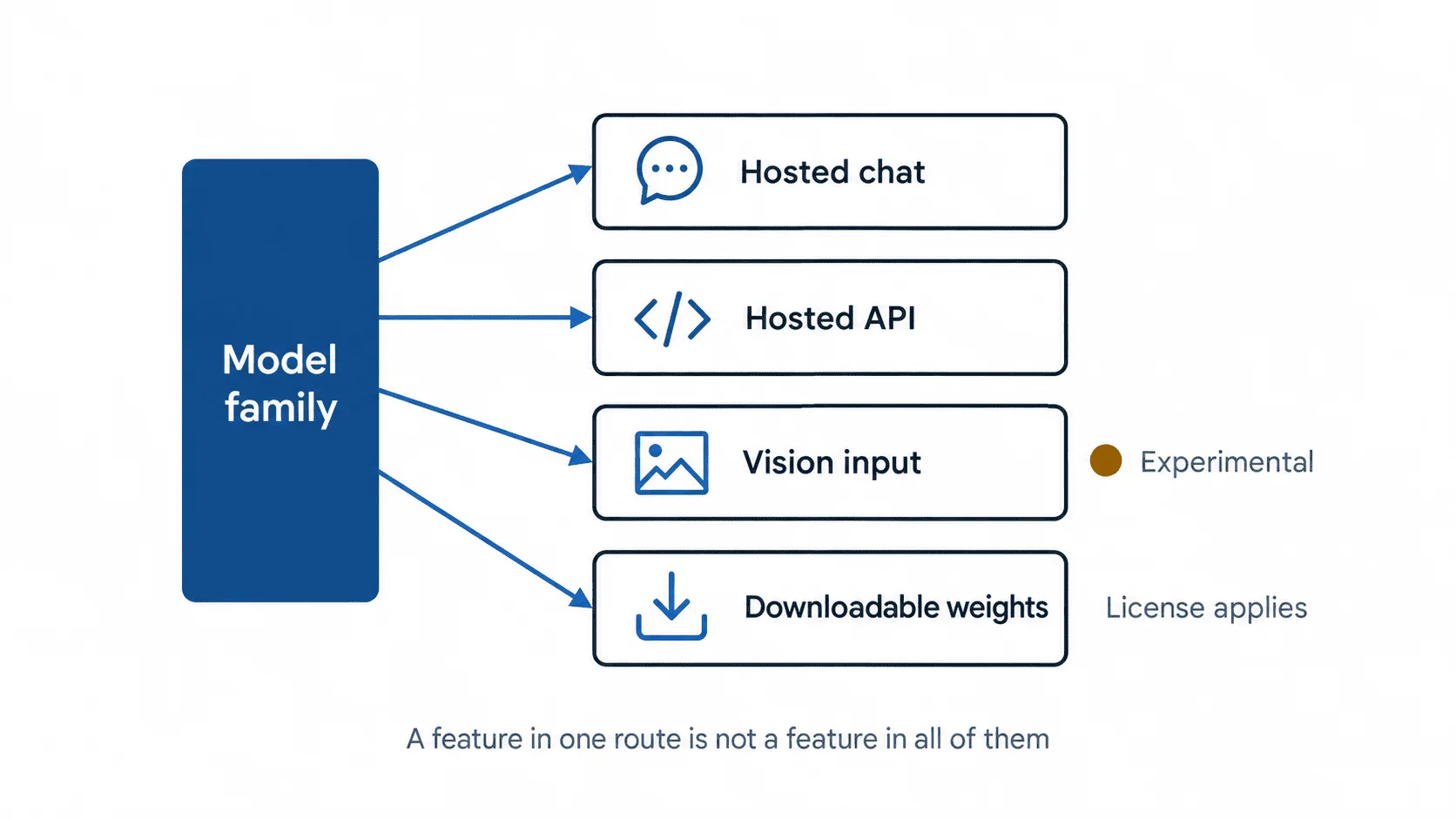
DeepSeek models are a family of general-purpose, reasoning, coding, vision, OCR, and mathematical AI models—not one single model. DeepSeek’s current Models & Pricing page and August 21, 2026 changelog list three hosted API IDs: the text-only deepseek-v4-flash and deepseek-v4-pro, plus the experimental multimodal deepseek-v4-flash-vision-exp. Flash serves DeepSeek-V4-Flash-0731 in public beta, Pro serves DeepSeek-V4-Pro-0813 in general availability, and Vision Exp accepts text with JPEG, PNG, GIF, or WebP images. DeepSeek documents the Responses API for all three models; Vision Exp is also documented for Chat Completions and Anthropic-compatible messages. DeepSeek has separately published downloadable model weights for the V4 Pro, V4 Flash, and V4 Flash Vision Exp lines, as well as R1, V3, V2, Coder, VL, Janus, OCR, Math, Prover, and related research families. A published checkpoint does not mean it is a current DeepSeek-hosted API ID; those are listed separately below.
The right choice depends on the task and access method. Start with V4 Flash for routine or high-volume text work, evaluate V4 Pro for harder text reasoning and agentic coding, and evaluate Vision Exp when a hosted request must combine text with images. Treat Vision Exp as experimental rather than a drop-in production default, and do not infer that it generates images or that the two text-only IDs accept them. For local work, consider an R1 Distill checkpoint or a specialist VL, Janus, OCR, Math, or Prover family. This guide separates hosted API IDs from downloadable weights and earlier releases so similarly named products are not mistaken for the same model.
Researching earlier releases? Use the DeepSeek model history for the verified V2, V3, V3.1, and V3.2 timeline, release dates, architecture changes, and historical API mappings.
For primary papers and technical reports behind these model families, use the DeepSeek research reading guide. If you need the broader company, product, and access picture, start with Seek-Chat.com’s independent DeepSeek guide.
Which DeepSeek Model Should You Use?
Use this quick model picker before comparing specifications. “Documented first-party API model” means the ID appears in DeepSeek’s current Models & Pricing page or dated changelog on the verification date. A dated GET /models observation is reported separately and must not be silently promoted into a current inventory. “Open weights” means model files are published for download under the license attached to that release.
| Task | Recommended starting point | Why |
|---|---|---|
| General chat, extraction, classification, or high-volume text API work | V4 Flash, non-thinking mode | The lower-cost, higher-concurrency V4 text model. |
| Difficult text reasoning, coding, or multi-step agents | V4 Pro, thinking mode | The larger GA text model for harder workloads. |
| Hosted screenshot, chart, photograph, or document-image understanding | V4 Flash Vision Exp | DeepSeek’s experimental hosted model for text-plus-image input; validate it before production use. |
| Long-document text processing at scale | V4 Flash, then test V4 Pro on difficult cases | Both text models list a 1M-token context window; Flash is the practical first evaluation for volume. |
| Full-size open-weight reasoning research | R1-0528 or R1 | Published reasoning checkpoints with 671B total and 37B activated parameters. |
| Smaller local reasoning deployment | R1 Distill | Published checkpoints range from 1.5B to 70B, with different hardware requirements. |
| Local code generation or repository experiments | DeepSeek Coder V2 | A code-specialized family with Lite and full mixture-of-experts variants. |
| Self-hosted document image-to-text research | DeepSeek OCR or OCR 2 | Downloadable specialist models; they are separate from the hosted Vision Exp API model. |
| Self-hosted visual question answering and document understanding | DeepSeek VL2 | A downloadable vision-language family for images, charts, documents, grounding, and visual Q&A. |
| Multimodal understanding and image-generation research | Janus-Pro | A separate downloadable research family; Vision Exp documentation does not establish image generation. |
| Lean theorem proving | DeepSeek Prover V2 | A specialist family for formal mathematical proof generation. |
DeepSeek Model List at a Glance
This DeepSeek model list groups checkpoints by purpose and access. It does not treat every Base, Instruct, quantized, or deployment repository as a separate model family.
| Model family | Primary role | Access and status verified September 3, 2026 | Guide |
|---|---|---|---|
| V4 Flash | Efficient text-only general, reasoning, coding, and agent workloads | API ID deepseek-v4-flash; serves DeepSeek-V4-Flash-0731 in public beta; native Responses API; no native image input documented | V4 family guide |
| V4 Pro | Larger text-only model for difficult reasoning, coding, and agent tasks | API ID deepseek-v4-pro; serves DeepSeek-V4-Pro-0813 in GA; native Responses API; no native image input documented | Pro vs Flash guide |
| V4 Flash Vision Exp | Experimental hosted multimodal understanding for text-plus-image requests | API ID deepseek-v4-flash-vision-exp; experimental hosted access; official open weights published separately; Chat Completions, Responses, and Anthropic-compatible messages; 1M context; 384K maximum output; FIM not supported | Vision Exp guide |
| R1, R1-Zero, R1-0528 | Reasoning research | Open weights; not listed as current first-party API IDs during verification | R1 guide and R1-0528 guide |
| R1 Distill | Smaller reasoning checkpoints | Open weights derived from Qwen or Llama base models; license terms vary by checkpoint | Sizes and selection |
| V3.2 | Reasoning, agents, and tool-use research | Open weights; earlier API generation; Speciale’s temporary endpoint ended December 15, 2025 | V3.2 guide |
| V3.1 and Terminus | Hybrid thinking and non-thinking research | Open weights; earlier API generation | V3.1 guide |
| V3 | General language, coding, and earlier MoE research | Open weights; earlier API generation; licenses differ by release | V3 guide |
| V2 and V2.5 | Earlier general and coding-capable MoE models | Downloadable weights; historical families under model-specific terms | V2 guide |
| Coder and Coder V2 | Code generation, completion, and repair | Specialized downloadable weights; not current first-party API IDs during verification | Coder guide |
| OCR and OCR 2 | Document and image-to-text extraction | Specialized downloadable weights; separate from the hosted Vision Exp API model | OCR guide |
| VL and VL2 | Vision-language understanding | Specialized downloadable weights; model-specific license | Vision section |
| Janus, JanusFlow, Janus-Pro | Multimodal understanding and image-generation research | Downloadable weights; code and model use have separate license terms | Janus overview |
| Math and Math V2 | Mathematical reasoning | Specialized downloadable research checkpoints | Math section |
| Prover and Prover V2 | Formal theorem proving in Lean | Specialized downloadable research checkpoints | Prover section |
| DeepSeek LLM and DeepSeek MoE | Earlier foundation-model research | Historical downloadable families | Timeline |
Models Currently Documented in DeepSeek’s First-Party API
DeepSeek’s current Models & Pricing page and August 21, 2026 changelog list deepseek-v4-flash, deepseek-v4-pro, and deepseek-v4-flash-vision-exp. All three list thinking and non-thinking modes, a 1M-token context window, a 384K maximum output, JSON Output, Tool Calls, Chat Prefix Completion, Responses API, and Anthropic-compatible access. Flash and Pro remain text-only endpoints. Vision Exp is the experimental text-and-image option and does not support FIM Completion. Feature availability still depends on the exact model, endpoint, mode, and current provider documentation.
| API model ID | Modality and status | Context / maximum output | Listed concurrency | Best first evaluation |
|---|---|---|---|---|
deepseek-v4-flash | Text only; public beta | 1M / 384K | 2,500 | Routine text tasks, long-context processing, and high-volume applications |
deepseek-v4-pro | Text only; GA | 1M / 384K | 500 | Difficult text reasoning, coding, and agentic workflows |
deepseek-v4-flash-vision-exp | Text plus image input; experimental | 1M / 384K | 2,500 | Screenshots, charts, photos, and document-image understanding; read the guide |
Pricing changes faster than the model catalog. Vision Exp currently follows the V4 Flash rate schedule, but this hub does not duplicate volatile token prices. Use our independent DeepSeek pricing guide and calculator for the current peak/off-peak table and worked examples, then verify the official Models & Pricing page before budgeting.
Model size alone does not establish quality for your workload. Test representative prompts, tool sequences, retrieval cases, latency, output length, and failure handling. V4 Pro is the stronger text model to evaluate on difficult or high-value tasks, while Vision Exp requires separate image-task evaluation because it is experimental. Every output still requires retrieval, validation, and human review where errors carry material consequences.
What are deepseek-chat and deepseek-reasoner?
They are moving compatibility aliases, not stable model-family names. DeepSeek used deepseek-reasoner for the hosted R1 service in January 2025, later upgraded that route to R1-0528 and then to newer thinking models, and mapped it to V4 Flash thinking mode before the announced V4 retirement cutoff. The April 24, 2026 notice said both old names would become unavailable after July 24, 2026 at 15:59 UTC. Our bounded July 28, 2026 GET /models observation and DeepSeek’s static List Models reference example showed only deepseek-v4-flash and deepseek-v4-pro; that evidence remains historical. DeepSeek’s current Models & Pricing page and August 21, 2026 changelog now also list deepseek-v4-flash-vision-exp. No authenticated GET /models rerun was made for this September 3, 2026 editorial review. The aliases’ changing post-cutoff behavior is not a support guarantee. Use a currently documented explicit ID and explicit thinking settings; do not infer a checkpoint or family from a legacy alias. See DeepSeek’s official change log and our dated API updates tracker.
Are V4 DSpark repositories separate models?
No. DeepSeek describes V4 Flash DSpark and V4 Pro DSpark as the same checkpoints with an additional speculative-decoding module for deployment. They are not extra first-party API model IDs. “Think Max” settings also describe inference configurations rather than separate models named V4 Pro Max or V4 Flash Max.
DeepSeek Models Comparison: V4 vs R1 vs V3
| Family | Main purpose | First-party hosted API status | When to consider it |
|---|---|---|---|
| V4 family | Text tasks, reasoning, coding, agents, long context, plus experimental image understanding | Flash-0731 public beta and Pro-0813 GA are the current text-only choices; Vision Exp is an additional experimental text-and-image model; all three are documented for Responses | You want DeepSeek-hosted access or want to evaluate V4 open weights; use Vision Exp only when image input is required |
| R1 / R1-0528 | Reasoning-focused open-weight research | Not listed as current official API IDs during verification | You want a published reasoning checkpoint or an R1 Distill model for local use |
| V3.2 / V3.1 / V3 | Earlier general, reasoning, and agent model generations | Earlier API generations, not listed as current API IDs during verification | You need to reproduce research, compare generations, or use a specific open checkpoint |
The key distinction is access, not only capability. A model can remain useful as downloadable weights after its hosted endpoint has changed or ended. A third-party provider may also serve an R1 or V3 checkpoint under its own endpoint, limits, and pricing; that does not make the checkpoint a model in DeepSeek’s first-party API.
DeepSeek R1 and R1 Distill Models
DeepSeek-R1 is a reasoning family built around a 671B-parameter mixture-of-experts architecture with 37B parameters activated per token and a 128K context window. R1-Zero is the reinforcement-learning research precursor, R1 is the released reasoning model, and R1-0528 is a later checkpoint update. These are open-weight releases, not interchangeable names for V4’s thinking mode. Our full breakdown of the R1 reasoning family, its distilled checkpoints and their licenses covers each variant in detail.
The original R1 collection includes six distilled checkpoints: Qwen-based 1.5B, 7B, 14B, and 32B models, plus Llama-based 8B and 70B models. DeepSeek also published R1-0528-Qwen3-8B. Smaller parameter counts can make evaluation more practical, but memory use still depends on precision, quantization, context length, KV cache, runtime, and concurrency. Review the DeepSeek system requirements before choosing a local checkpoint.
Licensing follows the specific checkpoint. R1 itself is MIT-licensed, while distilled releases also inherit relevant terms from their Qwen or Llama base models. Check both the DeepSeek model card and the upstream base-model license before commercial deployment.
V3, V3.1, V3.2, V2, and V2.5
These families document the development path that preceded V4. V3 introduced a 671B-total, 37B-activated mixture-of-experts model with a 128K context window. V3.1 added hybrid thinking and non-thinking operation, and V3.1 Terminus refined that line. V3.2 focused on reasoning efficiency and agents, including thinking with tools. V3.2-Speciale emphasized reasoning but did not support tool calling; its temporary official endpoint ended on December 15, 2025.
V2 and V2.5 are earlier 236B-total, 21B-activated families associated with DeepSeek’s mixture-of-experts and Multi-head Latent Attention work. They can matter for reproducibility, architecture study, or an application already built around a particular checkpoint. For a new first-party API integration, however, use the API IDs documented by DeepSeek for the verification date rather than assuming that a downloadable historical checkpoint has a hosted endpoint.
Coding, Math, and Theorem-Proving Models
DeepSeek Coder and Coder V2
DeepSeek Coder is the earlier dense code-model family. DeepSeek Coder V2 extends the code-focused line with mixture-of-experts models and a 128K context window: a Lite 16B-total/2.4B-activated variant and a full 236B-total/21B-activated variant. Its official model card describes support for 338 programming languages. Consider Coder V2 when you specifically want a downloadable code checkpoint; for a hosted DeepSeek coding workflow, benchmark V4 Flash and V4 Pro on your repositories, languages, tools, and tests. We cover the Coder and Coder V2 checkpoints, their sizes and what they are practical for separately.
DeepSeekMath and DeepSeek Prover
DeepSeekMath targets mathematical reasoning. DeepSeekMath-V2 extends that research toward self-verifiable reasoning and theorem-proving workflows. DeepSeek Prover is narrower: it generates formal proofs in Lean. Prover V2 has published 7B and 671B variants. Use general V4 or R1 models for broad natural-language mathematics; use Prover when formal Lean output is the actual task.
Vision, Multimodal, and OCR Models
DeepSeek’s visual products now require a three-way distinction. deepseek-v4-flash and deepseek-v4-pro remain text-only hosted API IDs. deepseek-v4-flash-vision-exp is a separate experimental hosted model for text-plus-image input. DeepSeek-VL, Janus, and OCR remain separate downloadable specialist families. Vision Exp does not make Flash or Pro multimodal, and its image-input documentation does not establish image generation.
- DeepSeek V4 Flash Vision Exp: experimental hosted text-and-image model. It accepts JPEG, PNG, GIF, and WebP via Base64, external URL, or Files API
file_id; images are billed as input tokens, with an upper bound of 384 input tokens per image after documented resizing. DeepSeek documents the Files API itself as free, while inference usage remains billable. - DeepSeek-VL and VL2: vision-language models for visual question answering, document and chart understanding, OCR-style tasks, and grounding. VL2 has Tiny, Small, and full variants with approximately 1.0B, 2.8B, and 4.5B activated parameters, respectively.
- Janus, JanusFlow, and Janus-Pro: multimodal research families spanning image understanding and image generation. Janus-Pro was published in 1B and 7B sizes. Its code is MIT-licensed, while model use is subject to the DeepSeek Model License.
- DeepSeek-OCR and OCR 2: 3B-class specialist models for visual document compression and image-to-text workflows. OCR model capacity is commonly discussed through visual-token budgets and image-resolution handling rather than a general text context figure.
Choose among them by testing the actual input types you process: scanned pages, photographed documents, charts, screenshots, diagrams, or natural images. OCR accuracy, reading order, tables, handwriting, grounding, and generation quality are different evaluation targets.
How DeepSeek Model Names Work
- Family name: V4, R1, V3, Coder, VL, Janus, and OCR identify broad lines with different purposes.
- Checkpoint or version: names such as R1-0528, V3-0324, V3.1 Terminus, and V3.2-Speciale identify a release or variant.
- API model ID: a lowercase string such as
deepseek-v4-proordeepseek-v4-flash-vision-expis sent in an API request. An API ID can identify a text-only model or an experimental multimodal model; it is not the same thing as a repository name. - Repository ID: a name such as
deepseek-ai/DeepSeek-V4-Proidentifies files and documentation in DeepSeek’s verified Hugging Face organization. - Base versus Instruct: Base checkpoints are intended for research, adaptation, or further training. Instruct or Chat checkpoints are tuned to follow user instructions.
- Thinking mode: a reasoning mode can be a runtime option for one API model. It does not automatically create a different model family.
Official API vs Open Weights vs Local Models
| Access type | What it means | What to verify |
|---|---|---|
| First-party DeepSeek API | DeepSeek hosts the model behind a documented API ID. | Model ID, endpoint, context, output limit, features, rate limits, and API pricing. |
| Official chat product | A model or mode is offered through DeepSeek’s own web or app interface. | The interface may not expose the same controls or naming as the API. |
| Open-weight checkpoint | Model files can be downloaded and deployed under the attached license. | License, precision, storage, RAM/VRAM, runtime support, context, and serving configuration. |
| Third-party hosted model | Another provider serves a DeepSeek checkpoint. | Exact checkpoint, modifications, data handling, region, limits, reliability, and provider pricing. |
Local deployment can give you more control over data flow, model files, and serving infrastructure, but it does not guarantee privacy by itself. Logs, prompts, backups, telemetry, retrieval systems, and access controls still require review. Use the local DeepSeek installation guide for deployment steps and the DeepSeek privacy checklist for a practical risk review.
DeepSeek Model Sizes and Context Windows
DeepSeek uses both dense and mixture-of-experts architectures. For an MoE model, total parameters describe the full architecture, while activated parameters estimate how much of it participates for each token. Activated parameters are useful for understanding compute, but they are not a direct promise of speed or memory use.
A context window is the model’s input-and-output token budget under a defined serving configuration. It is not a guarantee that the model will retrieve every fact correctly from a long prompt. Evaluate long-context work with realistic document placement, retrieval questions, citations, distractors, and output requirements. Maximum output limits can also differ from the context window and from limits imposed by a third-party runtime.
How to Choose a DeepSeek Model
- Choose hosted or self-hosted access. Use the first-party API when managed access is the priority. Use downloadable weights when you need infrastructure control, model adaptation, or reproducible research.
- Separate text from image input. Use V4 Flash or Pro for text-only requests. Use the experimental Vision Exp ID when the hosted request includes images. Use VL, Janus, or OCR when a downloadable specialist family better matches the task.
- Match reasoning effort to task difficulty. Start with V4 Flash for routine API traffic. Test V4 Pro on cases that need deeper reasoning or agent behavior. Compare accuracy, latency, and cost on the same dataset.
- Set an infrastructure ceiling. A full R1, V3, or published V4 Pro/Flash checkpoint is not a normal single-GPU deployment. Smaller R1 Distill, V2 Lite, or Coder V2 Lite checkpoints may be more practical, especially with validated quantization. Hosted API availability and downloadable weights are separate evidence. For Vision Exp, use the separately published checkpoint and model-card details linked in the Vision Exp guide.
- Verify the exact license. Do not assume every DeepSeek repository uses MIT. Review the model card, base-model terms, and commercial-use conditions for the exact checkpoint.
- Run a task-specific evaluation. Measure accuracy, unsupported claims, tool success, code test pass rate, format compliance, latency, token use, and recovery from failures. A public benchmark cannot replace your production test set.
DeepSeek Model Timeline
The table below is the short version. For how each generation actually replaced the last — release dates, what changed at each step, and which names were retired along the way — read our dated history of every DeepSeek model generation.
| Period | Family | Why it matters |
|---|---|---|
| 2023 | DeepSeek Coder and DeepSeek LLM | Established the early code and general language-model lines. |
| Early 2024 | DeepSeek MoE, Math, VL, and V2 | Expanded into MoE efficiency, mathematics, visual understanding, and MLA-based general models. |
| Mid to late 2024 | Coder V2, Prover, V2.5, VL2, and Janus | Added larger code, formal proof, unified general capability, and multimodal research families. |
| December 2024–March 2025 | V3 and V3-0324 | Introduced and refined the 671B-total/37B-activated V3 generation. |
| January–May 2025 | R1, R1 Distill, R1-0528, and Prover V2 | Published reasoning, distilled reasoning, and formal theorem-proving checkpoints. |
| August–December 2025 | V3.1, V3.1 Terminus, V3.2, Math V2, and OCR | Advanced hybrid reasoning, agents, mathematical verification, and document OCR research. |
| January–April 2026 | OCR 2 and V4 Preview | Extended OCR and introduced the V4 Flash and V4 Pro API and open-weight lines. |
| August 21, 2026 | DeepSeek-V4-Flash-Vision-Exp | Added an experimental first-party API model for text-plus-image requests. |
Are DeepSeek Models Open Source?
Many DeepSeek releases publish model weights and code, but “open source” should not be used as a blanket label for every family. Published V4 Pro/Flash checkpoints, R1, V3.1, V3.2, and several related releases use MIT terms, while V2, Coder V2, VL2, Janus models, earlier V3 checkpoints, and distilled models can have different or inherited conditions. Vision Exp has separately published open weights, as noted above; verify the exact checkpoint and its license in the linked model guide rather than inferring a license from API availability. Published weights also do not necessarily include the full training data, data pipeline, or every training artifact.
The precise statement is: DeepSeek has published many open-weight models under release-specific licenses. Check the repository for the exact checkpoint you plan to use. See the full DeepSeek open-source and licensing explanation.
Frequently Asked Questions
What DeepSeek models are available through the official API?
DeepSeek’s current Models & Pricing page and August 21, 2026 changelog list deepseek-v4-flash, deepseek-v4-pro, and the experimental multimodal deepseek-v4-flash-vision-exp. Our July 28, 2026 authenticated GET /models observation returned only Flash and Pro, and DeepSeek’s static List Models reference example still shows those two; no authenticated post-release rerun was made for this editorial update. Keep that July result as dated evidence rather than using it as today’s complete inventory. The old aliases were absent from the July result and remain unsafe production choices.
Which DeepSeek model should I use?
For text-only first-party API work, start with V4 Flash for routine or high-volume tasks and test V4 Pro for harder reasoning, coding, or agents. Use the experimental V4 Flash Vision Exp when the request must include screenshots, charts, photographs, or document images. For local reasoning, choose an R1 Distill size that fits your hardware. Use VL2, Janus-Pro, OCR, Math, or Prover only when its downloadable specialist task matches your workload.
What is the difference between DeepSeek V4, R1, and V3?
V4 is the current family represented by the text-only deepseek-v4-flash and deepseek-v4-pro API IDs plus the experimental text-and-image deepseek-v4-flash-vision-exp ID. Flash serves Flash-0731 in public beta, Pro serves Pro-0813 in GA, and Vision Exp is documented as experimental; all three support Responses. R1 is a reasoning-focused open-weight family with distilled variants. V3, V3.1, and V3.2 are earlier general, hybrid-reasoning, and agent-oriented open-weight generations.
Is deepseek-reasoner the same as DeepSeek R1?
Historically, yes—but not as a permanent identity. DeepSeek launched the hosted R1 API behind deepseek-reasoner in January 2025 and later moved that alias through R1-0528, V3-series thinking models, and V4 Flash thinking mode. The alias therefore does not identify a fixed checkpoint today. For R1 specifically, use its published model card or open-weight checkpoint name; for the current hosted API, choose an explicit ID from the current Models & Pricing documentation and verify account-level availability independently.
Can DeepSeek models run locally?
Many published checkpoints can be self-hosted, but practicality varies widely. Full published V4 Pro/Flash, R1, V3, and Coder V2 checkpoints require substantial storage, memory, and serving infrastructure. Vision Exp also has separately published weights; their existence does not establish that a particular local machine can run them. Check the exact model card, runtime, and hardware requirements. R1 Distill and Lite variants are more realistic starting points for smaller systems.
Which DeepSeek model is best for coding?
For DeepSeek’s hosted API, evaluate V4 Flash and V4 Pro with your languages, repositories, tools, and tests. For a downloadable code-specialized checkpoint, Coder V2 is the dedicated family. “Best” depends on test-pass rate, context needs, tool reliability, latency, and deployment constraints.
Does DeepSeek have vision and image models?
Yes. The hosted deepseek-v4-flash-vision-exp API model is experimental and accepts text with JPEG, PNG, GIF, or WebP images; V4 Flash and V4 Pro remain text-only. Separately, DeepSeek-VL and VL2 address downloadable vision-language understanding, Janus covers multimodal understanding and image-generation research, and DeepSeek-OCR addresses document image-to-text work. Image input does not imply image generation. See the Vision Exp guide.
Are all DeepSeek models free to use commercially?
No single answer applies to every checkpoint. Some releases use MIT or Apache 2.0, while others use a DeepSeek Model License or inherit Qwen or Llama terms. Review the exact model card and upstream license before commercial use.
What are R1 Distill models?
They are smaller Qwen- or Llama-based models trained using outputs associated with the R1 reasoning family. Published sizes include 1.5B, 7B, 8B, 14B, 32B, and 70B, plus R1-0528-Qwen3-8B. They are not compressed copies with identical behavior; evaluate each checkpoint independently.
How often should the DeepSeek model list be checked?
Check official API documentation before an integration or migration, and verify the exact model card before downloading weights. This page records a verification date because API IDs, aliases, limits, checkpoints, and license terms can change independently.
Official Sources and Verification Method
Current documented API availability, context limits, model IDs, modalities, and Vision Exp status were checked against DeepSeek’s Models & Pricing page, August 21, 2026 changelog and release note, and Vision guide. The July 28, 2026 GET /models result remains a separately dated observation and was not rerun for this editorial update. Parameter counts, intended uses, and licenses were checked against model cards and collections in DeepSeek’s verified Hugging Face organization. A repository’s displayed file size was not treated as the model’s architectural parameter count.
- DeepSeek API Models & Pricing
- DeepSeek V4 Preview release notice
- DeepSeek API changelog, including the August 21, 2026 Vision Exp release
- DeepSeek V4 Flash Vision Exp release note
- DeepSeek Vision guide
- DeepSeek’s verified Hugging Face organization
- Official DeepSeek V4 collection
- Official DeepSeek R1 collection
- Official DeepSeek V3.2 model card
- Official DeepSeek Coder V2 model card
- Official DeepSeek VL2 collection
- Official Janus collection
- Official DeepSeek OCR collection
- Official DeepSeek Prover collection
Editorial note: Model availability is date-sensitive. Check the current Models & Pricing page and changelog before changing production traffic, and run your own authenticated model-list check where account-level availability matters. Do not treat the July 28, 2026 observation or the static List Models example as a live August 21, 2026 inventory. Verify the model card and license for the exact downloadable checkpoint before deployment.