Seek-Chat: DeepSeek vs Mistral: Which AI Model Should You Use for Coding, Reasoning, Cost, and Privacy?
DeepSeek vs Mistral, live evidence from July 28, 2026; current DeepSeek contract rechecked August 24, 2026: DeepSeek currently serves three hosted API IDs: the text-only deepseek-v4-flash and deepseek-v4-pro, plus the experimental deepseek-v4-flash-vision-exp, which accepts text and images and returns text. All three list 1M-token context and maximum output up to 384K. Mistral’s current documentation describes a platform that includes multimodal models, coding agents, document tools, smaller open-weight models, and organization controls. This feature inventory does not establish overall platform superiority. Neither provider is the universal winner; the right choice depends on the product layer and workload you are actually comparing.
Competitor source check — September 7, 2026. Mistral’s model documentation was re-read on this date: Mistral Medium 3.5 is the current featured model and Mistral Medium 3.1 (mistral-medium-2508) is listed as retired with Medium 3.5 as its replacement. Mistral’s model overview does not state a license for Medium 3.5, so no license claim for it is made here; the pricing and DPA statements retain their July 28, 2026 checkpoint.
Evidence disclosure — documentation-based comparison; DeepSeek tested, Mistral not tested live. On July 28, 2026, we checked DeepSeek’s live model endpoint and ran one controlled reasoning task through DeepSeek Chat and the API. We did not have authenticated access to Mistral Vibe or Studio and did not collect Mistral outputs, latency, token use, or quality scores. Mistral capabilities, prices, privacy controls, and product descriptions are attributed to first-party materials checked on the dates stated below. Price-table arithmetic is not an identical-job cost test, and this page does not claim a cross-provider winner for quality, coding, multimodal accuracy, speed, privacy, or cost per accepted result.
DeepSeek vs Mistral: the short answer
- For an initial DeepSeek benchmark, use V4 Flash for text-only inputs and Vision Exp for supported image inputs. The two routes share DeepSeek’s current Flash pricing schedule and published account-level concurrency limit. This is a routing distinction within DeepSeek, not evidence that either route outperforms a Mistral model.
- For image tasks, compare Mistral Small 4 with DeepSeek Vision Exp on the same inputs and scoring rules. Mistral’s capabilities in this article are based on first-party documentation; no matched Mistral output was collected for this revision.
- Include DeepSeek V4 Pro and Mistral Medium 3.5 in a matched evaluation for difficult coding and agent tasks. This article has not measured which model is more accurate, faster, or less expensive per completed repository task.
- Use a product-specific privacy review. DeepSeek Chat, DeepSeek’s Open Platform, Mistral Vibe, Mistral’s API, partner hosting, and self-hosting have different terms and controls.
- Do not migrate by alias alone. On July 28, 2026, DeepSeek’s legacy aliases still responded in our account, despite the previously announced retirement date. Treat that as temporary observed behavior, not a compatibility promise.
First, compare the right products
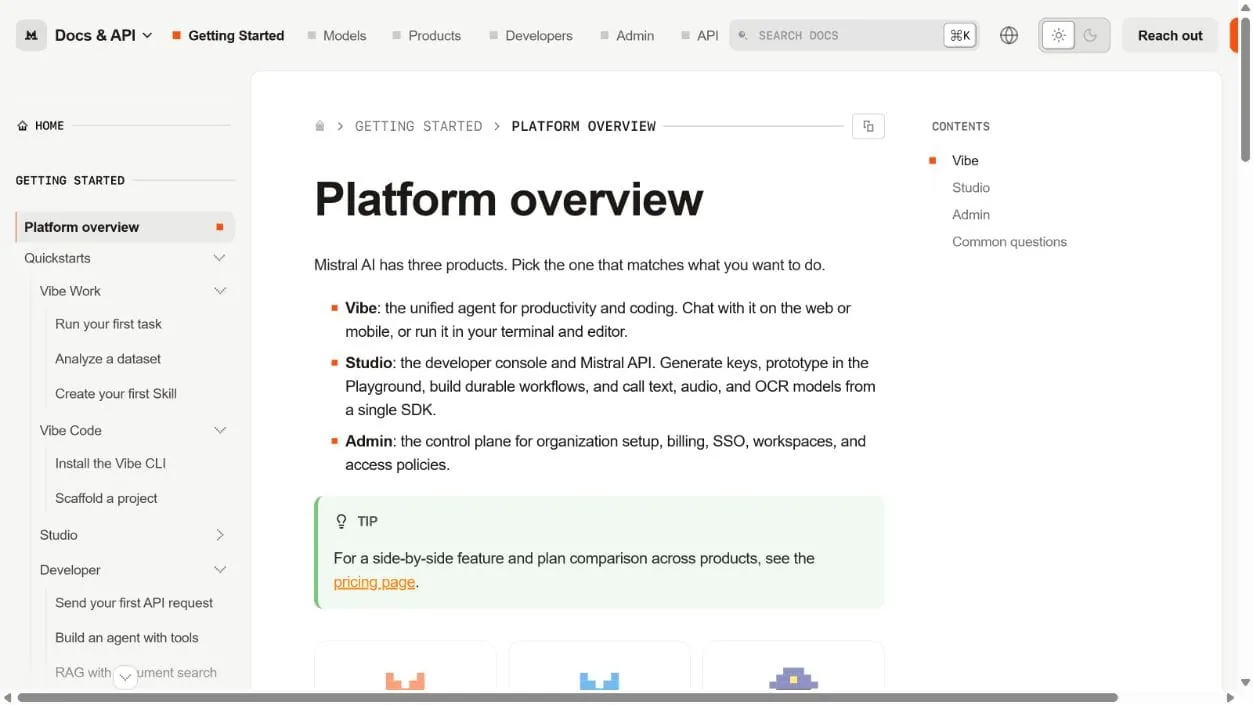
“DeepSeek” and “Mistral” are not single interchangeable apps. DeepSeek has a consumer chat service, a hosted API, and open-weight V4 releases. Mistral’s current platform overview describes three products: Vibe for productivity and coding, Studio for API keys, prototyping, agents, evaluations, and usage, and Admin for organizations, billing, SSO, workspaces, and policies.
Mistral Vibe itself has Work, Code, and Chat modes. Its documentation says Chat includes legacy features migrated from Le Chat. Therefore, a current consumer comparison is DeepSeek Chat versus Mistral Vibe Chat or Work—not DeepSeek’s API versus an older Le Chat feature list. A developer comparison is DeepSeek’s Open Platform versus Mistral Studio and the Mistral API.
| Decision layer | DeepSeek option | Mistral option | What to measure |
|---|---|---|---|
| Everyday assistant | DeepSeek Chat | Vibe Chat or Work | Answer quality, files, research, citations, task completion |
| Hosted model API | V4 Flash, V4 Pro, or Vision Exp | Small 4, Large 3, Medium 3.5, or a specialist model | Correctness, latency, tokens, tool cost, retries |
| Coding agent | V4 with your agent harness | Vibe Code, Medium 3.5, or current Codestral v25.08; Devstral 2 is retired | Test pass rate, valid diffs, supervision, cost per solved issue |
| Private deployment | DeepSeek open weights | Mistral open weights | License, hardware, throughput, security, operational cost |
What we verified live on DeepSeek
Our July 28, 2026 request to the DeepSeek /models endpoint returned deepseek-v4-flash and deepseek-v4-pro. We also called the legacy deepseek-chat and deepseek-reasoner names. Both returned HTTP 200 and mapped to deepseek-v4-flash; the reasoner request included reasoning_content. DeepSeek’s April V4 announcement had said those aliases would become inaccessible after July 24, 2026. The live result records only what this account observed on July 28, 2026. It does not guarantee that another account, region, or later request will behave the same way. New integrations should use the current explicit model IDs.
We also sent one controlled vendor-selection task that required strict JSON and had a deterministic answer. In DeepSeek Chat, Instant mode made a contradictory, incorrect selection, while Expert mode selected the correct vendor. Through the API, V4 Flash returned the correct answer in 2,160 ms. V4 Pro consumed a 500-token reasoning allowance without producing a final answer on the first attempt; with a 1,600-token maximum it answered correctly in 12,259 ms.
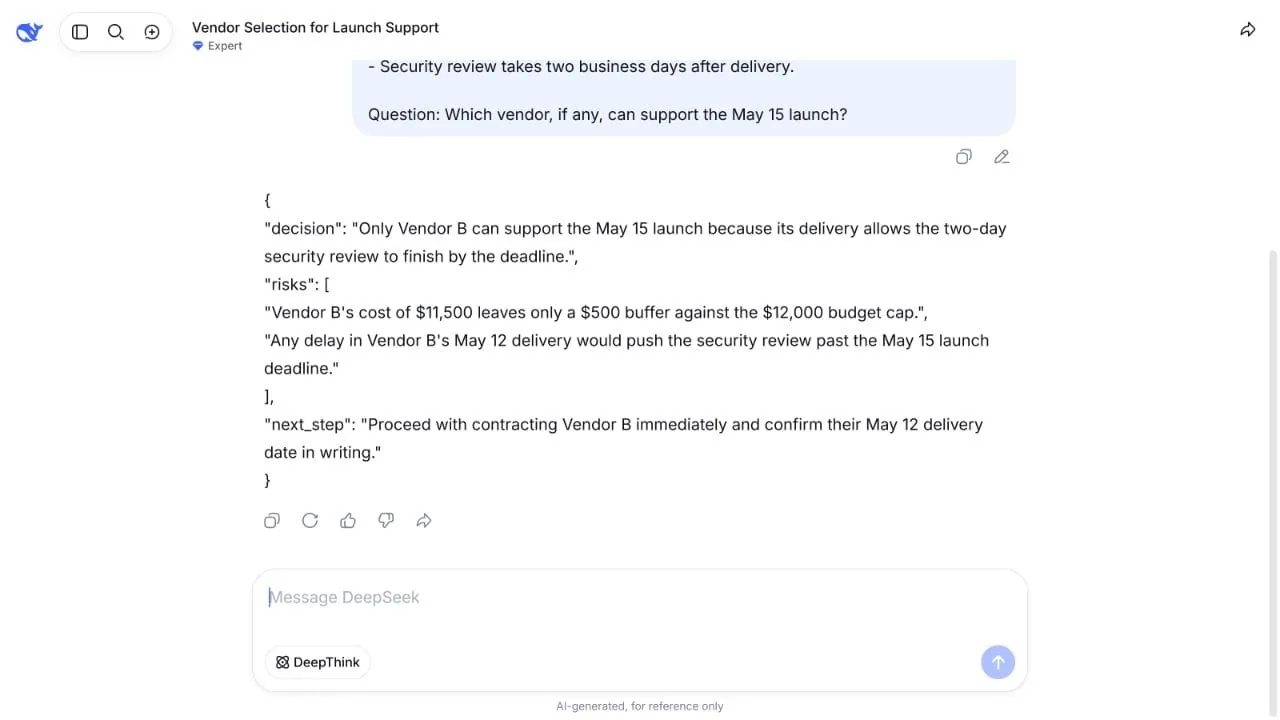
What this proves: mode choice and reasoning-token allowance can change task completion, and a faster or more expensive model should not be assumed to be correct. What it does not prove: that DeepSeek is better or worse than Mistral overall. No Mistral output was collected for this task.
The result is also a useful production warning. A reasoning model can spend its entire allowance before emitting a user-visible final answer. Your evaluation harness should distinguish “correct,” “incorrect,” “invalid format,” and “no final answer,” and it should include total latency and retry cost. See our DeepSeek evaluation framework and thinking-mode guide for implementation details.
Current models and specifications
DeepSeek’s official model page lists three current IDs with 1M context, maximum output up to 384K, thinking and non-thinking modes, JSON output, tool calls, Responses, Anthropic compatibility, and chat-prefix completion. FIM Beta is limited to non-thinking Flash and Pro with a 4K completion ceiling; Vision Exp does not support FIM. Mistral’s official cards list 256K context for Small 4, Large 3, and Medium 3.5. Those Mistral cards also document multimodal support and API features including structured outputs, function calling, agents, built-in tools, document Q&A, and batching.
| Model | Official context | Input modality | Positioning relevant to this comparison |
|---|---|---|---|
| DeepSeek V4 Flash | 1M | Text | Economical V4 API and Instant-mode foundation; maximum output 384K |
| DeepSeek V4 Pro | 1M | Text | Higher-capability V4 and Expert-mode foundation; maximum output 384K |
| DeepSeek V4 Flash Vision Exp | 1M | Text + images in; text out | Experimental visual understanding at Flash pricing; maximum output 384K |
| Mistral Small 4 | 256K | Multimodal | 119B parameters, 6.5B active; hybrid instruct, reasoning, and coding model |
| Mistral Large 3 | 256K | Multimodal | 675B total, 41B active; general-purpose open-weight MoE |
| Mistral Medium 3.5 | 256K | Multimodal | Mistral positions this model for agentic and coding workloads; that positioning was not independently tested in this revision. |
A larger advertised context window is capacity, not guaranteed retrieval quality. If the task fits inside 256K tokens, Mistral remains a candidate where its documented platform tools or document-processing routes match the requirements. That does not establish better output quality. Compare the applicable Mistral multimodal model with DeepSeek Vision Exp on the same workload. If substantially more source text is required in one request, DeepSeek’s 1M specification is relevant—but lost-in-the-middle errors, latency, citations, and cost must still be tested at the expected prompt lengths.
DeepSeek vs Mistral API pricing
The following prices were checked against the providers’ official pages on July 28, 2026 and are quoted per one million tokens in USD. Prices can change. They exclude taxes, retries, storage, fine-tuning, partner markups, and tool calls. The DeepSeek rows are that dated snapshot and are not relabeled here; DeepSeek bills at different off-peak and peak rates, and the current off-peak, peak and cache-hit figures are on our pricing page.
| Hosted model | Input / 1M | Output / 1M | Important qualification |
|---|---|---|---|
| DeepSeek V4 Flash | $0.14 cache miss; $0.0028 cache hit | $0.28 | Current explicit model ID |
| DeepSeek V4 Pro | $0.435 cache miss; $0.003625 cache hit | $0.87 | Reasoning can consume substantial output allowance |
| Mistral Small 4 | $0.15 | $0.60 | Multimodal, open-weight model |
| Mistral Large 3 | $0.50 | $1.50 | Multimodal open-weight MoE |
| Mistral Medium 3.5 | $1.50 | $7.50 | Multimodal agentic/coding model |
| Devstral 2 | $0.40 | $2.00 | Agentic coding model in the July 28, 2026 snapshot; now listed under Deprecated & retired |
| Codestral v25.08 | $0.30 | $0.90 | Completion, FIM, and code generation; current Code models entry |
| Magistral Medium | $2.00 | $5.00 | Reasoning-focused model in the July 28, 2026 snapshot; listed versions are now under Deprecated & retired |
Current DeepSeek API pricing (verified August 24, 2026): Peak applies only Monday–Friday during 01:00–04:00 and 06:00–10:00 UTC, equivalent to 09:00–12:00 and 14:00–18:00 Beijing time; every other period is off-peak. Flash and Vision Exp share off-peak cache-hit / cache-miss / output rates of $0.007 / $0.22 / $0.66 and peak rates of $0.014 / $0.44 / $1.32. Pro rates are $0.022 / $0.66 / $1.98 off-peak and $0.044 / $1.32 / $3.96 peak. Account-level concurrency is 2,500 for Flash, 500 for Pro, and 2,500 for Vision Exp across all API keys. Use the current pricing page and DeepSeek API cost reference for new budgets. Any dated prices, test costs, or arithmetic elsewhere on this page remain historical and have not been recomputed.
Using the July 28, 2026 price snapshot retained in the historical rows above, a workload of 10 million cache-miss input tokens and two million output tokens would have produced approximately $1.96 for V4 Flash, $6.09 for V4 Pro, $2.70 for Mistral Small 4, $8.00 for Mistral Large 3, and $30.00 for Mistral Medium 3.5. These figures are historical arithmetic, not current quotes and not a quality-adjusted comparison. Recalculate the same workload from both providers’ current rate pages before budgeting.
Mistral’s API pricing page advertises 50% batch pricing and a 90% cached-input discount. Apply those discounts only where the workload and endpoint are eligible. It also charges separately for Agent API tools: its checked page lists libraries, code execution, web search, images, premium news, and data capture. An agent budget must combine model tokens, tool calls, retries, indexing, and storage instead of comparing token rates alone. DeepSeek’s cache-hit prices can likewise change the economics of repeated prefixes; read the context-caching guide before forecasting.
Coding, reasoning, and agents
Official descriptions put both providers in the coding and agent market. DeepSeek positions V4 around long context and agentic coding. Mistral positions Medium 3.5 for agentic and coding workloads, retains Codestral v25.08 for high-frequency completion and fill-in-the-middle, and exposes Vibe Code in the terminal, editor, and remote sessions. Its current Models Overview places Devstral 2 in the Deprecated & retired section.
Those are product capabilities, not proof of which model will solve more of your issues. Repository work should be evaluated with executable tests: check out the same commit, give each agent the same issue and tool budget, run the project’s test suite, inspect the diff, and record whether a human had to repair it. Do not mix Vibe Code’s complete product with a bare DeepSeek model call and attribute every difference to the underlying model.
Our one DeepSeek JSON task also cautions against a simplistic “reasoning always wins” assumption. Expert and V4 Pro succeeded when enough room was available, but the first Pro request produced no final answer at 500 reasoning tokens. Production systems need an explicit timeout, output validation, retry policy, and maximum cost. For structured applications, combine the provider’s native mode with schema validation; our DeepSeek JSON output guide explains the DeepSeek side.
Multimodal work, OCR, and documents
Mistral documents multimodal models, OCR, and document-processing tools for image and scanned-document workflows. These are documented capabilities, not independently measured accuracy results. DeepSeek’s Vision Exp provides a different image-understanding route that should be compared on the same source files and expected answers. Vision Exp accepts text and images but returns text; it is not an image-generation model. Flash and Pro remain text-only.
DeepSeek’s Files API is for JPEG, PNG, GIF, and WebP images only; it is not general PDF, DOCX, spreadsheet, archive, Batch, or File Search ingestion. PDF analysis can still work after reliable text extraction, or by rendering relevant pages to supported images for Vision Exp, but that is a pipeline comparison: extractor or page renderer plus model versus Mistral’s applicable document route. Test tables, multi-column pages, footnotes, handwriting, and citation coordinates separately. Never claim one provider “understands PDFs better” from a clean-text sample.
API integration and platform breadth
DeepSeek supports OpenAI-compatible Chat Completions and Responses plus an Anthropic-format base URL, which can reduce migration work. Compatibility is not identity: Responses is stateless, so previous_response_id, conversation, store, and background must not be treated as working server-side state. Use all three current IDs by exact capability and follow the V4 migration guide rather than relying on the legacy aliases observed in our dated check.
In thinking Chat requests that include tools, replay the complete assistant reasoning_content in every subsequent user-interaction turn even when no tool call occurred; without tools, replay is not required and is ignored if sent. For Flash and Pro, current effort mapping is low→low, medium/high/xhigh→high, and max→max; DeepSeek does not publish that mapping as a Vision-specific contract. FIM remains a separate Beta /completions surface at https://api.deepseek.com/beta, with a 4K completion ceiling, Flash/Pro non-thinking support, and no Vision support.
Mistral Studio covers keys, a Playground, agents, evaluations, monitoring, and workflows. The API includes chat completions, functions, structured output, agents, conversations, built-in tools, document libraries, batch processing, OCR, speech, embeddings, and moderation. DeepSeek can be included in evaluations of focused text endpoints and supported image-understanding tasks. Mistral documents a wider set of managed services, which may reduce integration work when those services are required; this article did not measure implementation time or total integration cost.
Open weights, licenses, and self-hosting
Both providers publish open weights. DeepSeek’s V4 materials describe MIT-licensed weights and code, with V4 Pro at 1.6 trillion total parameters and 49 billion active per token, and V4 Flash at about 284 billion total and 13 billion active. Mistral Large 3 is a 675-billion-parameter MoE with 41 billion active, Small 4 has 119 billion parameters and 6.5 billion active, and Medium 3.5 is a 128-billion dense model under a Modified MIT license.
“Open weights” does not mean easy deployment, zero cost, or automatic compliance. Measure the exact checkpoint, quantization, accelerator, runtime, context length, concurrency, memory, tokens per second, and recovery behavior. Review each model’s exact license before commercial use. Mistral also publishes self-deployment guidance; operational documentation is useful but does not replace your capacity and security assessment. For DeepSeek deployment basics, see how to run DeepSeek locally.
Privacy, retention, and enterprise review
Privacy conclusions must be tied to a product and account plan. Mistral’s current privacy policy states that your input and output may be used to improve its models subject to an opt-out you can exercise in your account preferences, and that third-party content is not used to train its models. The plan-by-plan developer documentation we cited previously — Vibe Free versus Pro, Team and Enterprise defaults, API zero-data-retention status, and a Labs exception under which data could be used for training regardless of subscription or opt-out — has since been withdrawn from Mistral’s documentation. We rechecked on September 7, 2026 and could not confirm those plan-level details against any current primary source, so we no longer state them. Confirm plan-level retention and training behavior with Mistral directly before relying on it.
Mistral’s DPA effective July 27, 2026 generally frames the customer as controller and Mistral as processor, while documenting limited controller activities and contractual safeguards. That can help procurement, but a DPA or European vendor location is not proof that a particular deployment satisfies every law or internal policy.
DeepSeek’s consumer-service privacy policy covers official services that link to it and describes collection of prompts, uploads, chat history, device and log data, model-improvement use with an opt-out right, and processing and storage in the People’s Republic of China. The policy explicitly says that downstream applications built through the Open Platform must publish their own end-user processing rules. DeepSeek’s Open Platform terms also assign the downstream operator responsibilities for notices, legal basis, rights requests, and safeguards.
Before sending confidential or regulated data to either provider, verify the exact service, region, contract, retention, training setting, zero-retention status, logs, subprocessors, support access, deletion workflow, and incident obligations. Self-hosting can increase infrastructure control, but the operator then owns access control, encryption, monitoring, patching, retention, safety testing, and incident response.
A reproducible DeepSeek vs Mistral benchmark
An honest cross-provider result requires authenticated Mistral Vibe and Studio access. Until that is available, this page does not award a quality, speed, or coding winner. The following protocol is designed to turn the comparison into dated evidence without mixing products.
- Test DeepSeek Chat and Mistral Vibe separately from the APIs. Record date, region, plan, mode, visible product label, tools, and file limits.
- For the economy API tier, compare V4 Flash with Mistral Small 4. For harder coding and agent tasks, compare V4 Pro with Medium 3.5. Add specialist Mistral models only for tasks they are designed to solve.
- Use 30 synthetic English tasks: ten coding problems with unit tests, five deterministic reasoning problems, five strict JSON/tool-call cases, five long-context retrieval cases, and five image/document cases.
- Route image cases to
deepseek-v4-flash-vision-expand the selected Mistral multimodal model; mark Flash and Pro image input unsupported. Keep PDF/document ingestion as a separate pipeline comparison because DeepSeek Files accepts images only. - Repeat stochastic tasks three times. Save exact model ID, settings, input and output tokens, cache tokens, latency, retries, errors, final-answer status, tool charges, and calculated cost.
- Score test pass rate, schema validity, tool-name and argument validity, retrieval accuracy, unsupported claims, and cost per successful task. Publish failures as well as successes.
Use synthetic documents and repositories so screenshots and raw results can be published without exposing customer data, API keys, account IDs, billing values, or private chats. Provider defaults may differ; document them instead of pretending that unlike controls are identical.
How to Build a Shortlist from the Available Evidence
| Your priority | Candidate evaluation | Why this is only a starting point |
|---|---|---|
| Time-aware low-cost text generation | Compare DeepSeek V4 Flash off-peak/peak with Mistral Small 4 | Input mix, cache hits, output length, quality, and retries decide the result |
| 1M-token text capacity | DeepSeek V4 Flash, Pro, or Vision Exp | Measure retrieval accuracy at your actual length |
| Image understanding | Compare DeepSeek Vision Exp with Mistral Small 4, Large 3, or Medium 3.5 | Choose by visual quality and price; evaluate document ingestion as a separate route |
| Packaged coding-agent workflow | Compare Mistral Vibe Code with an equivalent DeepSeek-based agent harness | No matched end-to-end coding-agent test was run |
| Managed organization controls | Evaluate Mistral Admin and contract | Verify settings and legal fit; do not infer compliance |
| Open-weight deployment | Shortlist both families | Hardware and license fit can dominate model preference |
The practical conclusion remains conditional. Include DeepSeek V4 Flash for text workloads and Vision Exp for supported image tasks, using the applicable peak or off-peak rates. Include the relevant Mistral product when its documented specialist services, Vibe workflows, document routes, open-weight sizes, or organization controls match the requirement. These are candidates for testing, not measured winners. For high-value coding, visual, and agent decisions, run the same executable workload on the matched products before committing.
Frequently asked questions
Is DeepSeek better than Mistral?
There is no general winner supported by this evidence. DeepSeek documents 1M context across its current hosted models, time-dependent pricing, and a Vision Exp image-understanding route. Mistral documents multimodal models, a broader tool and product portfolio, multiple open-weight sizes, and organization controls. Test the exact model, time band, and product route for your workload.
Which is cheaper, DeepSeek or Mistral?
There is no single rate that answers this now. DeepSeek changes prices by cache status and Monday–Friday peak/off-peak time; Flash and Vision share one price schedule, while Pro uses a higher schedule. The Mistral rows above preserve the July 28, 2026 snapshot and its documented batch/cache qualifications. Actual cost depends on time band, input/output mix, cache hits, Mistral batch or cache eligibility, tool charges, failed requests, and human correction. Compare cost per accepted result.
Which is better for coding?
Both target coding, but the products differ. DeepSeek offers inexpensive V4 model access for a custom harness. Mistral offers Medium 3.5, current Codestral v25.08, and Vibe Code; Devstral 2 is retired. No coding winner is claimed here because Mistral was not tested live. Use repository tasks with compilation and unit tests.
Do both Mistral and DeepSeek support image input?
Certain current routes from both providers document image input. Mistral’s current Small 4, Large 3, and Medium 3.5 cards describe multimodal capabilities, while DeepSeek image input is limited to the experimental Vision Exp route. These documented capabilities were not compared in a matched visual-accuracy test.
Can I still use deepseek-chat and deepseek-reasoner?
Both aliases returned HTTP 200 and routed to V4 Flash in our July 28, 2026 check, even though DeepSeek had announced retirement after July 24, 2026. This is a dated observation, not a guarantee. New integrations should choose an explicit current ID by capability: deepseek-v4-flash or deepseek-v4-pro for text, or deepseek-v4-flash-vision-exp for image understanding, and should test migration explicitly.
Which is safer for private data?
Neither brand name answers that question. Compare the exact consumer, API, partner-hosted, or self-hosted route; its contract and region; retention and training settings; logs and subprocessors; and your own controls. In the public materials reviewed for this revision, Mistral provided more explicit documentation of managed organization settings. That observation is limited to the cited documentation and does not establish better privacy, security, or regulatory compliance.
Update log
- September 7, 2026: rechecked Mistral’s current model catalog and dated every competitor claim on this page; restated the peak windows in UTC and Beijing time.
- August 24, 2026: updated only the current DeepSeek layer for the third Vision Exp ID, image input, image-only Files API, 1M/384K limits, weekday peak/off-peak pricing, concurrency, Responses state, reasoning replay, effort mapping, and FIM boundaries; preserved the July 28, 2026 tests and Mistral snapshot.
- July 28, 2026: rebuilt the comparison around current DeepSeek V4 IDs and Mistral Vibe, Studio, and Admin; checked official specifications, prices, privacy controls, and the July 27, 2026 Mistral DPA. Recorded live DeepSeek
/models, legacy-alias, Chat mode, and API JSON-task observations; no Mistral account test was performed. Method change on the same date: removed unsupported universal winner claims and separated product, API, and open-weight comparisons.
Official sources and next steps
Primary sources checked for this update include DeepSeek’s models and pricing, V4 announcement, Privacy Policy, and Open Platform terms; plus Mistral’s platform overview, API pricing, current model cards, privacy policy, and DPA.
Continue with the DeepSeek V4 guide, compare current DeepSeek models, review DeepSeek pricing, or start an implementation with the DeepSeek API guide. Before switching an existing application, audit SDK compatibility with our OpenAI SDK migration guide and validate tool behavior with the tool-calling guide.