Seek-Chat: DeepSeek API Updates: Changelog and Deprecated Models Tracker
DeepSeek API updates require three separate answers: what DeepSeek officially documents, what changed in the latest dated release, and what the hosted API accepted at a specific moment. On August 21, 2026, DeepSeek released the experimental multimodal DeepSeek-V4-Flash-Vision-Exp model behind deepseek-v4-flash-vision-exp. The current official matrix now lists that ID beside deepseek-v4-flash, serving DeepSeek-V4-Flash-0731 in public beta, and deepseek-v4-pro, serving DeepSeek-V4-Pro-0813 in GA. Separate bounded tests from July 28, 2026 remain dated compatibility evidence from before the Vision release; they do not replace the current official catalog or create a support guarantee.
Practical conclusion: use explicit current IDs: start with
deepseek-v4-flashfor text, evaluatedeepseek-v4-prowhere stronger capability justifies its higher rate, and use the experimentaldeepseek-v4-flash-vision-expwhen a request must process images. Do not treat the July 28, 2026 compatibility behavior as a cancellation of the announced retirement, a support guarantee, or evidence that an unlisted name will keep working. Compatibility routing can change without becoming a new first-party lifecycle promise.
Official sources reviewed: August 24, 2026 · Latest official release: August 21, 2026 · Existing live compatibility test: July 28, 2026, 22:44 UTC · Requests: 7 planned and 7 observed · Retries: 0 · Temporary key: revoked after the run
Latest DeepSeek API update — quick answer
- Current documented API IDs:
deepseek-v4-flash,deepseek-v4-pro, anddeepseek-v4-flash-vision-exp. - July 28, 2026 live inventory — pre-Vision:
GET /modelsreturned Flash and Pro only. Vision Exp had not yet been released, so this dated result is not the current catalog. - Legacy cutoff: the V4 release notice announced July 24, 2026 at 15:59 UTC as the point after which
deepseek-chatanddeepseek-reasonerwould be inaccessible. - Post-cutoff observation: on July 28, 2026, the two legacy names and
deepseek-coderreturned HTTP 200 in this account and reporteddeepseek-v4-flashas the returned model. - Developer action: migrate to an explicit V4 ID and treat old-name acceptance as temporary compatibility only.
- Latest official changelog entry: on August 21, 2026, DeepSeek released the experimental
DeepSeek-V4-Flash-Vision-Expmodel on the API platform. - Current release scope: Flash remains
DeepSeek-V4-Flash-0731in public beta; Pro servesDeepSeek-V4-Pro-0813in GA; Vision Exp servesDeepSeek-V4-Flash-Vision-Expas an experimental image model. - Responses API scope:
POST /responsessupports all three current models and remains stateless. Vision Exp accepts image URLs, Base64 data URLs, or an imagefile_idfrom the Files API; arbitrary document and general file input remain unsupported.
For observed behavior rather than lifecycle status, see the dated DeepSeek Responses compatibility results: 48 live model-case results across Flash and Pro, with 34 PASS and 14 FAIL under frozen assertions.
What changed since the July 25, 2026 check?
| Probe | July 25, 2026 observation | July 28, 2026 observation | Interpretation |
|---|---|---|---|
GET /models | Flash and Pro | Flash and Pro | No inventory change observed |
deepseek-v4-flash | HTTP 200 | HTTP 200 | Current documented ID accepted |
deepseek-v4-pro | HTTP 200 | HTTP 200 | Current documented ID accepted |
deepseek-chat | HTTP 400 | HTTP 200 → Flash | Unlisted compatibility behavior changed |
deepseek-reasoner | HTTP 400 | HTTP 200 → Flash | Observed with thinking explicitly disabled |
deepseek-coder | HTTP 400 | HTTP 200 → Flash | Historical name accepted but still unlisted |
| Synthetic invalid control | HTTP 400 | HTTP 400 | The endpoint still rejected an unknown control |
The July 25, 2026 and July 28, 2026 runs used the same seven-operation structure and short synthetic marker contract, but this tracker does not claim that every hidden routing condition or provider-side rollout variable was identical. The defensible finding is narrower: the observed result changed. That is precisely why production code should not infer lifecycle policy from one request.

/models listed Flash and Pro, while three unlisted old names returned HTTP 200 and routed to Flash; the invalid control returned HTTP 400.Current DeepSeek API model status
| Exact request ID | Access and status verified August 24, 2026 | July 28, 2026 /models | July 28, 2026 chat result | Production action |
|---|---|---|---|---|
deepseek-v4-flash | Current ID; serves DeepSeek-V4-Flash-0731 in public beta | Listed | HTTP 200; returned Flash | Use explicitly for cost-sensitive text workloads and Responses API access |
deepseek-v4-pro | Current ID; serves DeepSeek-V4-Pro-0813 in GA | Listed | HTTP 200; returned Pro | Use explicitly for higher-capability workloads |
deepseek-v4-flash-vision-exp | Current experimental ID; serves DeepSeek-V4-Flash-Vision-Exp | Not applicable—released August 21, 2026 | Not tested—not yet released | Use for documented image workloads; validate its experimental behavior and limits |
deepseek-chat | Past announced discontinuation cutoff | Not listed | HTTP 200; returned Flash | Migrate; do not depend on compatibility routing |
deepseek-reasoner | Past announced discontinuation cutoff | Not listed | HTTP 200; returned Flash with thinking disabled | Migrate and set thinking behavior explicitly |
deepseek-coder | Historical API name; no current listing | Not listed | HTTP 200; returned Flash | Replace with an explicit current ID |
The first three rows are current documented IDs as of August 21, 2026. The July 28, 2026 columns are intentionally historical: Vision Exp did not exist then, while the old-name rows remain dated compatibility observations. A name can be accepted without appearing in /models; it can also stop being accepted later. Check the official model-list reference, the current pricing and model matrix, and a small live probe before any production change.
Official lifecycle status vs observed API behavior
This tracker uses four evidence levels and never substitutes one for another:
- Official lifecycle statement: a dated DeepSeek page explicitly announces a launch, migration window, cutoff, deprecation, or removal.
- Current documented contract: the model matrix, endpoint schema, rate-limit guide, or feature guide describes present behavior.
- Dated live observation: one bounded account and payload produced a recorded HTTP result at a specific UTC time.
- Inference: a cautious interpretation supported by the preceding evidence but not stated by DeepSeek as policy.
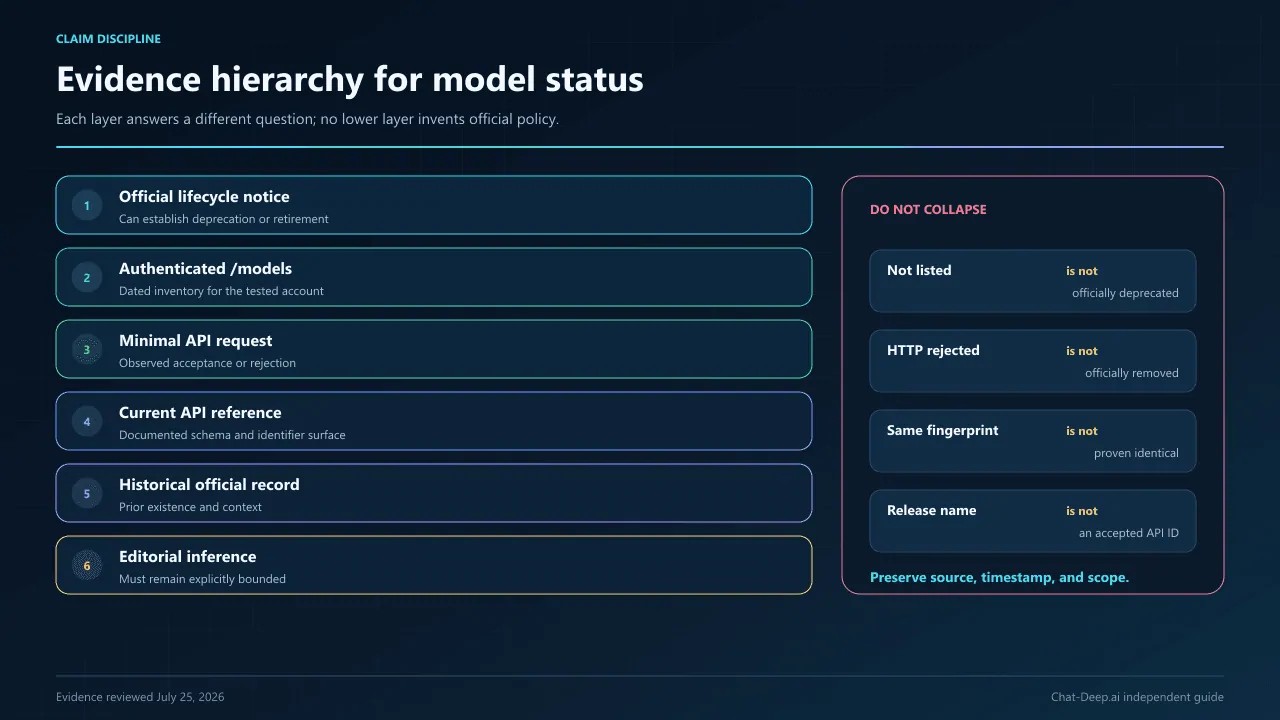
The V4 notice is first-party evidence that DeepSeek intended the two legacy aliases to become inaccessible after the cutoff. The July 28, 2026 response is live evidence that they were accepted for this test despite that notice. The responsible conclusion is not that retirement was “reversed.” It is that runtime compatibility and the announced lifecycle did not align in the July 28, 2026 observation; current acceptance would require a new dated probe.
Current API contract watchlist
Not every important API change appears as a dated changelog entry. The following current-contract details can break assumptions even when the model ID stays the same.
| Surface | Current documented behavior reviewed August 24, 2026 | Developer impact |
|---|---|---|
| Thinking mode | Flash, Pro, and Vision Exp support thinking and non-thinking modes. The separately documented Flash/Pro Chat contract uses direct effort values low, high, and max, while compatibility values medium and xhigh map to high; this tracker does not extend that effort mapping to Vision Exp without explicit first-party confirmation. | Set the mode explicitly, and apply effort values only where the exact model and endpoint document them |
| OpenAI Chat Completions images | Vision Exp accepts an image_url block for Base64 or URL, or a file block with an image file_id. | Use the Vision model and the Chat Completions content shape; other current models do not process the image |
| Responses API | POST /responses supports all three models and remains stateless. Vision Exp accepts input_image with URL, Base64 data URL, or image file_id; stored conversations, previous_response_id, arbitrary documents, and general file input remain unsupported. | Resend full history and distinguish a Files API image reference from unsupported generic file input |
| Anthropic-compatible images | Vision Exp accepts an image content block whose source is Base64, URL, or source.type=file. Files API references require anthropic-beta: files-api-2025-04-14. Document blocks and general file input remain unsupported. | Adapt the content block and required beta header to the Anthropic schema instead of copying an OpenAI request unchanged |
| Context and output | All three models list 1M context and up to 384K maximum output | Client-side limits and cost guards should not assume older V3-era caps |
| Concurrency | 2,500 for Flash, 2,500 for Vision Exp, and 500 for Pro | Separate scheduling and capacity planning by exact model |
| Penalty parameters | frequency_penalty and presence_penalty are marked deprecated and ineffective | HTTP acceptance does not mean those fields change sampling |
| Queued inference | DeepSeek documents keep-alive traffic while queued and may close a request that has not started inference within 10 minutes | Use timeouts, cancellation, and idempotent retries instead of blind replay |
| FIM Completion (Beta) | DeepSeek’s current Models & Pricing matrix lists FIM for deepseek-v4-flash and deepseek-v4-pro in non-thinking mode only; deepseek-v4-flash-vision-exp is unsupported. Use https://api.deepseek.com/beta with the /completions endpoint; the FIM maximum output is 4K. | Allowlist Flash and Pro, disable thinking, reject Vision Exp, and do not treat the FIM guide’s Pro-only example as an exclusion of Flash. |
For implementation detail, use the dedicated guides for Vision Exp image input, DeepSeek thinking mode, API rate limits, tool calls, context caching, and error handling. This page records the status boundary; it does not duplicate every integration tutorial.
Current V4 pricing snapshot
Current prices were rechecked on August 24, 2026 and are in US dollars per one million tokens. Current off-peak and peak rows for all three documented IDs appear first; the two historical pre-cutover Flash and Pro rows are retained only as a dated reference. Vision Exp and Flash share the same listed token rates, but Vision images add billed input tokens.
| Rate period | Model | Input: cache hit | Input: cache miss | Output |
|---|---|---|---|---|
| Current off-peak | deepseek-v4-flash | $0.007 | $0.22 | $0.66 |
| Current peak | deepseek-v4-flash | $0.014 | $0.44 | $1.32 |
| Current off-peak | deepseek-v4-flash-vision-exp | $0.007 | $0.22 | $0.66 |
| Current peak | deepseek-v4-flash-vision-exp | $0.014 | $0.44 | $1.32 |
| Current off-peak | deepseek-v4-pro | $0.022 | $0.66 | $1.98 |
| Current peak | deepseek-v4-pro | $0.044 | $1.32 | $3.96 |
| Historical — through August 16, 2026, 15:59 UTC | deepseek-v4-flash (DeepSeek-V4-Flash-0731) | $0.0028 | $0.14 | $0.28 |
| Historical — through August 16, 2026, 15:59 UTC | deepseek-v4-pro (DeepSeek-V4-Pro-0813) | $0.003625 | $0.435 | $0.87 |
Current pricing: DeepSeek applies peak rates during 01:00–04:00 and 06:00–10:00 UTC (09:00–12:00 and 14:00–18:00 Beijing time) from Monday through Friday. All other weekday hours are off-peak, and Saturdays and Sundays use off-peak rates all day. Peak rates are twice the current off-peak rates. Images sent to Vision Exp are converted into tokens and billed with text input, so equal token rates do not guarantee an equal request total.
Do not reuse historical caching prices or older statements that there is no concurrency limit. Those descriptions were correct for earlier API generations, not the current V4 contract. Check the official price page before budgeting and use our DeepSeek pricing guide for worked calculations.
DeepSeek API changelog — newest first
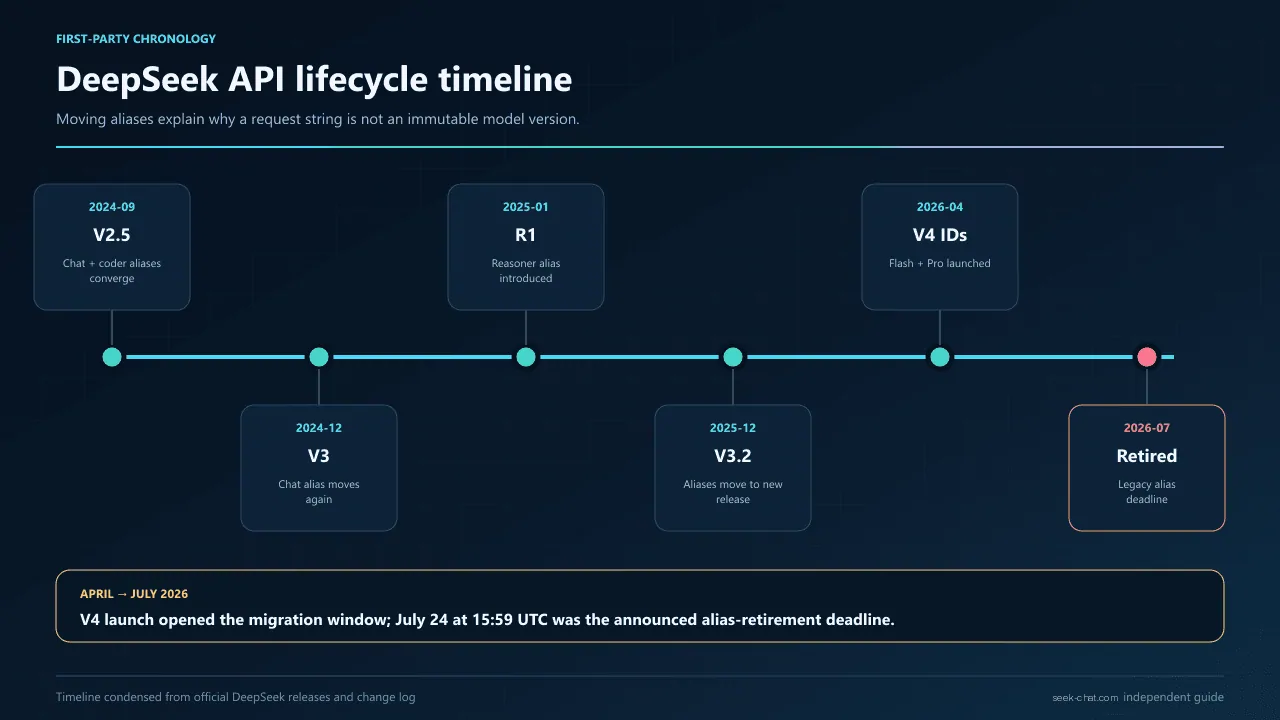
The official change log shows why a stable-looking alias is not a pinned model version. The same names moved through multiple model families before V4 introduced explicit first-class IDs.
| Date | Official event | Operational impact |
|---|---|---|
| 2026-08-21 | DeepSeek-V4-Flash-Vision-Exp released as an experimental API model with image input, Files API references, and support across Chat Completions, Responses, and Anthropic-compatible messages | Add the third current ID, choose the interface-specific image block, preserve general file/document limits, and validate experimental behavior |
| 2026-08-23 00:00 Beijing time | Weekend pricing changed: Saturdays and Sundays, determined by the Beijing calendar date, became off-peak for the whole day. This change is not carried as a dated entry in DeepSeek’s official Change Log; the first-party source is the Models & Pricing page, which states peak hours as 01:00–04:00 and 06:00–10:00 UTC (09:00–12:00 and 14:00–18:00 Beijing time), Monday through Friday, with all other hours off-peak. Rechecked September 7, 2026. | Make weekend cost estimates use the off-peak rate; a schedule that only distinguishes hours will overcharge Saturday and Sunday traffic |
| 2026-08-16 16:00 UTC | The published peak/off-peak API pricing schedule took effect | Use the current time-aware rate for the request timestamp; preserve earlier costs as historical evidence |
| 2026-08-13 | DeepSeek-V4-Pro-0813 rolled out as GA on App, Web, and API; Pro gained native Responses API support; the exact peak/off-peak pricing schedule and August 16, 2026 cutover were published | Update current model/version matrices, enable Pro on Responses clients, and make pricing logic time-aware |
| 2026-08-05 | Documentation check: the pricing page previewed a future 2× peak-rate policy during two daily Beijing-time windows, with no effective date announced at that time | Historical documentation state; superseded by the exact August 13, 2026 schedule |
| 2026-07-31 | DeepSeek-V4-Flash-0731 released in public beta with native Responses API support and Codex adaptation | Flash changed at that date; Pro-0813 followed on August 13, 2026 |
| 2026-07-24 15:59 UTC | Announced cutoff for deepseek-chat and deepseek-reasoner passed | Applications should already target explicit V4 IDs; the date came from the April V4 notice |
| 2026-04-24 | DeepSeek-V4 Flash and Pro launched for OpenAI Chat Completions and Anthropic-format access | New IDs, 1M context, dual thinking modes, and a legacy migration window |
| 2025-12-01 | Aliases upgraded to DeepSeek-V3.2; temporary V3.2-Speciale endpoint announced | In-place alias behavior changed and a separate endpoint had its own expiry |
| 2025-09-29 | Aliases upgraded to DeepSeek-V3.2-Exp | Experimental model behavior arrived behind familiar request strings |
| 2025-09-22 | DeepSeek-V3.1-Terminus update | Language consistency and agent behavior changed without new alias names |
| 2025-08-21 | DeepSeek-V3.1 launched | Hybrid reasoning and stronger agent capabilities reached the API aliases |
| 2025-05-28 | deepseek-reasoner upgraded to R1-0528 | Reasoning, JSON output, and function-calling behavior changed |
| 2025-03-24 | deepseek-chat upgraded to V3-0324 | Reasoning, coding, writing, search, and function calling improved |
| 2025-01-20 | DeepSeek-R1 introduced through deepseek-reasoner | A new reasoning family used an API alias rather than a pinned release ID |
| 2024-12-26 | deepseek-chat upgraded to DeepSeek-V3 | Major family change behind the same request name |
| 2024-09-05 | Chat and Coder merged into DeepSeek-V2.5 with both aliases retained | Two names temporarily converged on one model family |
| 2024-08-02 | Context caching on disk launched | Input-cost and latency behavior changed independently of model naming |
| 2024-07-25 | JSON output, function calling, chat prefix completion, and FIM features announced | Endpoint capability expanded without a model-retirement event |
For the current developer-preview install path and its verified boundaries, see the DeepSeek Harness 0.1.1 guide. The exact reproducible npm package verified by that guide is the prerelease @deepseek-ai/[email protected], not a stable @deepseek-ai/[email protected] package.
The authoritative chronology is the DeepSeek change log. The V4 release notice supplies the V4 model names, compatibility window, and announced cutoff. This tracker adds dated runtime evidence and operational interpretation; it does not replace first-party policy.
Deprecated, retired, unlisted, historical, and rejected are different
- Deprecated: a first-party source warns that a field or identifier is being phased out.
- Scheduled for retirement or discontinuation: a first-party source provides a cutoff after which access is expected to end.
- Unlisted: an identifier does not appear in the current
/modelsinventory. This is evidence about discoverability, not a complete lifecycle statement. - Historical: a name appears in old official documentation but is not presented as a current model ID.
- Observed accepted or rejected: one request returned a specific HTTP result at a specific time. It does not define future support.
That vocabulary matters here. deepseek-chat and deepseek-reasoner are past an announced discontinuation cutoff, yet were observed accepted on July 28, 2026. deepseek-coder is a historical name that was also accepted, but this tracker found no current first-party statement restoring it as a supported model ID.
What developers need to change now
- Replace old names with
deepseek-v4-flashordeepseek-v4-proin code, configuration, queues, dashboards, fixtures, and alert rules. - Choose the successor by workload quality, latency, concurrency, and cost—not by assuming an old alias will keep its current route.
- Set thinking behavior explicitly and regression-test the response fields your application consumes.
- Run a small canary with the exact production payload shape, including tools, JSON output, streaming, and timeout behavior where applicable.
- Make retries idempotent and stop retrying permanent model or validation errors.
- Keep a reversible fallback that uses a tested current model ID, not another undocumented alias.
Use the complete deepseek-chat and deepseek-reasoner to V4 migration guide for replacement code, rollout gates, queue handling, canaries, and rollback. Use the DeepSeek API testing guide for mocks, regression fixtures, streaming tests, and a separately gated live smoke test.
How this tracker verifies DeepSeek API changes
The July 28, 2026 candidate set and seven-call ceiling were fixed before execution. Calls were sequential, automatic retries were disabled, and each successful Chat Completion had to return the exact synthetic marker TRACKER_OK. The chat payload used explicit non-thinking mode, temperature zero, a 16-token output ceiling, and no private or user-derived content.
| Evidence field | Recorded value |
|---|---|
| UTC window | 2026-07-28 22:44:31.979Z to 22:44:36.454Z |
| Inventory request | HTTP 200 in 426 ms; exactly Flash and Pro listed |
| Current-model probes | Flash HTTP 200 in 321 ms; Pro HTTP 200 in 284 ms |
| Old-name probes | Chat, Reasoner, and Coder each HTTP 200 in 281–284 ms |
| Invalid control | HTTP 400 with a sanitized invalid_request_error classification |
| Successful usage | 11 prompt + 4 completion = 15 total tokens per successful marker request |
| Credential lifecycle | Dedicated temporary key created for the run, revoked, and verified absent in the provider interface |
No API key, Authorization header, account identifier, balance, completion ID, raw response, raw provider error, raw system_fingerprint, or private prompt is published. The test did not measure model quality, regional availability, sustained reliability, rate-limit enforcement, architecture, or billing accuracy. One successful request cannot promise that a compatibility route will exist tomorrow.
Update ledger and freshness policy
| Date | Source review | Live test | Material finding |
|---|---|---|---|
| 2026-08-21 | Yes | No | Official Vision Exp release and image/Files API contract added; no new live model request was run for this prose update |
| 2026-07-28 | Yes | Yes | Inventory unchanged; three unlisted old names changed from observed HTTP 400 to HTTP 200 compatibility routing |
| 2026-07-25 | Yes | Yes | Flash and Pro accepted; Chat, Reasoner, Coder, and invalid control returned HTTP 400 |
| 2026-04-24 | Official event | Not a tracker run | V4 Flash and Pro announced with a three-month legacy-name migration window |
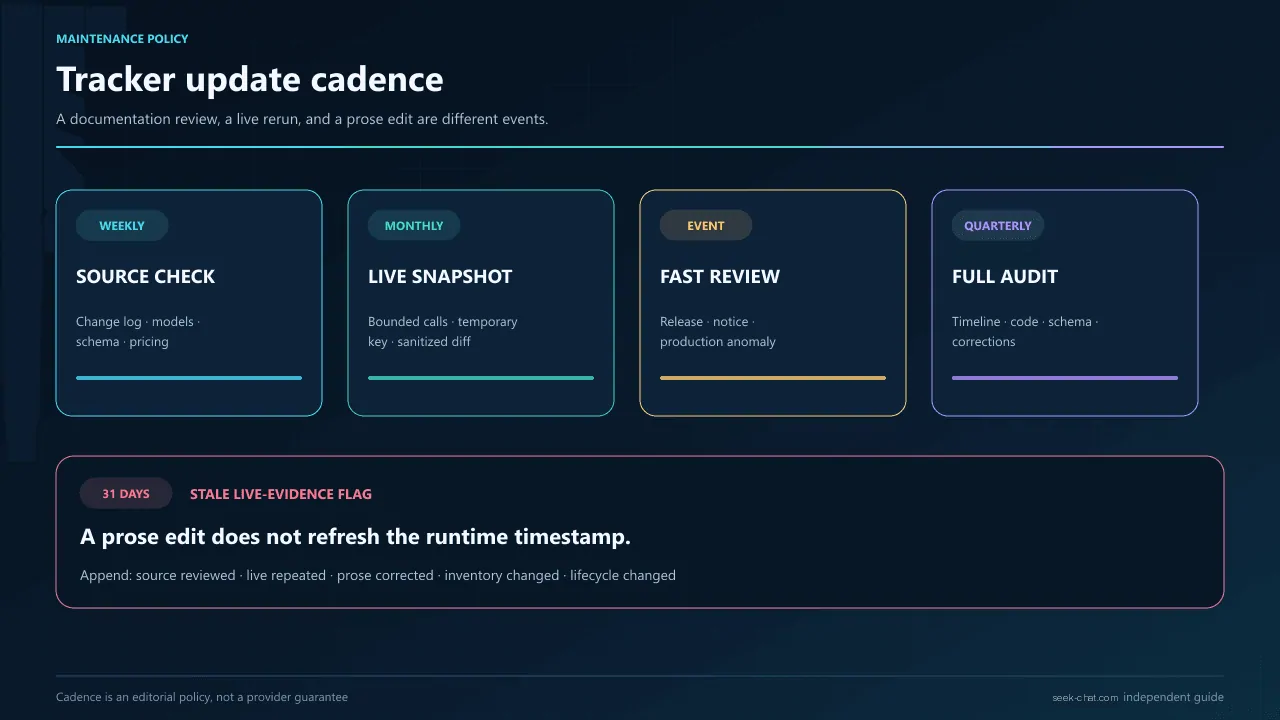
A documentation review, live test, and prose edit are recorded separately. This page is reviewed after a dated DeepSeek announcement, a model-list change, a reported compatibility break, or a material contract change. A prose-only correction never receives a new live-test date.
Limitations
- Hosted behavior may differ by time, account, rollout cohort, region, endpoint family, or payload shape.
- The test used OpenAI-format Chat Completions and did not test the Anthropic-format endpoint.
- The July 28, 2026 test predates Vision Exp. It did not test the new model, image input, or the Files API; current documentation claims are labeled separately from that runtime evidence.
- The
deepseek-reasonerprobe explicitly disabled thinking; it does not establish the default mode of that compatibility route. - Returned model labels do not expose weights, prove architectural identity, or guarantee stable routing.
- Some generated examples and endpoint schemas are narrower than the current capability matrix. For model eligibility, use the live Models & Pricing table together with the specialized feature guide and the dated release note. A one-model example does not exclude another model listed as supported. Verify runtime behavior with a bounded canary, but do not rewrite the published support catalog from a generated example.
- Pricing and concurrency are time-sensitive. Recheck the official pages before production budgeting.
Frequently asked questions
What is the latest DeepSeek API update?
The latest dated first-party changelog entry is the August 21, 2026 release of the experimental DeepSeek-V4-Flash-Vision-Exp model behind deepseek-v4-flash-vision-exp. It adds documented image input and Files API image references across supported request formats. The July 28, 2026 alias results remain dated pre-Vision compatibility evidence, not a lifecycle promise.
Which DeepSeek model IDs are currently documented?
deepseek-v4-flash, deepseek-v4-pro, and deepseek-v4-flash-vision-exp. The July 28, 2026 live /models result showed only Flash and Pro because it predates the August 21, 2026 Vision release.
Does DeepSeek now support image and file input?
Vision Exp supports images through OpenAI-compatible Chat Completions, Responses, and Anthropic-compatible messages. Each route supports a documented Base64, URL, or Files API image-reference shape. The Files API route here is for supported images; arbitrary documents, general file input, and Responses input_file remain unsupported.
Do deepseek-chat and deepseek-reasoner still work?
They worked for this one bounded July 28, 2026 test and returned deepseek-v4-flash. They are not listed by /models, and DeepSeek’s V4 notice announced that they would become inaccessible after July 24, 2026 at 15:59 UTC. Treat the successful responses as temporary compatibility evidence and migrate anyway.
What replaces deepseek-chat and deepseek-reasoner?
For legacy text workloads, use deepseek-v4-flash or deepseek-v4-pro and configure thinking mode explicitly. Flash and Vision Exp share the lower listed token rates, but Vision Exp is experimental and should be selected for image input rather than as an alias replacement. Test the exact workload instead of selecting from the old alias name alone.
Does a model missing from /models mean it cannot be called?
No. The July 28, 2026 test is a counterexample: three unlisted old names were accepted. Missing from /models means the identifier is not in the current advertised inventory. It does not, by itself, prove rejection or future removal.
How can I check the current DeepSeek model list?
Send an authenticated GET https://api.deepseek.com/models request, compare the returned IDs with the official model and pricing pages, then run one low-cost schema check against the exact candidate model. Keep that live check outside the default unit-test path.
Where should I monitor official DeepSeek API changes?
Monitor the official DeepSeek change log, API documentation, models and pricing page, and dated news posts. Use this independent tracker for post-cutoff observations and operational interpretation.
Official sources
- DeepSeek Change Log
- DeepSeek Vision Exp Release Note
- DeepSeek Vision Guide
- DeepSeek Files API
- DeepSeek Responses API Guide
- DeepSeek Anthropic API Guide
- DeepSeek V4 Preview Release
- List Models API
- Create Chat Completion
- Models and Pricing
- Thinking Mode
- Rate Limit and Isolation
- Context Caching
- FIM Completion Reference
Related DeepSeek developer guides
- DeepSeek API documentation guide
- Migrate deepseek-chat and deepseek-reasoner to V4
- Test DeepSeek API calls with mocks and live checks
- DeepSeek model comparison
- DeepSeek pricing guide
- DeepSeek error codes
Editorial disclosure: Seek-Chat.com is independent from DeepSeek and is not endorsed by DeepSeek. First-party claims are linked to official sources; runtime findings are labeled with their test date and scope.